It started with a porch light.
Not a dramatic emergency. Not a scream for help. Just one small light that failed to turn on for three nights in a row.
Most adults on our street never noticed.
But my six-year-old son did.
And by the next morning, our quiet neighborhood would be filled with police cars, dozens of piggy banks, crying grown adults, and a truth about kindness none of us were prepared for.
The Night Everything Changed
It was nearly bedtime when Oliver stopped in the hallway holding his toothbrush.
“Mom,” he said quietly, “Mrs. Adele’s porch light is still off.”
I looked out the window toward the little yellow house across the street.
Dark.
Completely dark.
No kitchen light.
No television glow.
No porch lamp.
Just silence.
“She probably went to sleep early,” I told him, even though something about it felt wrong.
Oliver frowned.
“No. Mrs. Adele always leaves her porch light on because she says it helps people find their way home.”
That sentence hit harder than it should have.
A few days earlier, I’d seen Mrs. Adele standing by her mailbox clutching a stack of unopened bills. She laughed them off when I asked if she was okay.
“Just bills, honey,” she’d said. “They come whether you invite them or not.”
I offered to help.
She refused politely.
Like so many elderly people, she had mastered the art of struggling quietly.
A Child Notices What Adults Miss
Oliver disappeared into his room and came back holding his little green piggy bank.
The thing was scratched up and covered with dinosaur stickers.
“I want to help her,” he said.
I smiled sadly.
“Sweetheart, grown-up bills are expensive.”
He hugged the piggy bank tighter.
“Then I’ll help a little.”
I tried to explain that adults would handle it.
But Oliver looked at me with heartbreaking seriousness.
“She gives me candy after school. She asks about my spelling tests. She says I’m getting smarter every week.”
He swallowed hard.
“You always help people, Mom. I want to help too.”
There are moments when your child says something so pure it exposes how complicated adults have become.
So I grabbed my coat.
“Okay,” I said. “Your gift. My help. We’ll do it together.”
Inside the Cold House
Mrs. Adele took a long time to answer the door.
When she finally opened it, she was wearing a winter coat indoors.
Her house was freezing.
No lights.
No heat.
No sound except the wind outside.
“Oh, Carmen,” she whispered. “I didn’t want anyone worrying.”
“How long has your power been out?”
She looked away.
Oliver answered for her.
“Three nights.”
Mrs. Adele’s eyes filled with tears.
Oliver reached into his pocket and handed her a sandwich bag full of coins.
Birthday money.
Tooth fairy dollars.
Quarters.
Pennies.
Everything he had.
“This is for your lights,” he said.
Mrs. Adele covered her mouth.
“Oh honey… no. I can’t take your savings.”
“Yes, you can,” Oliver replied firmly.
“That money belongs to you.”
“You told me good people don’t count what they give.”
At that moment, Mrs. Adele broke down crying.
And honestly?
So did I.
The Post That Changed Everything
After putting Oliver to bed, I started making phone calls.
Utility companies.
Senior services.
Emergency assistance lines.
Then, frustrated and exhausted, I made a short post in our local neighborhood group.
I explained that our elderly neighbor had lost power and my six-year-old son had emptied his piggy bank trying to help her.
I expected maybe a few comments.
Instead, the internet exploded.
People started sharing memories.
Hundreds of them.
“She paid for my lunch when my family couldn’t.”
“She used to sneak extra food into my backpack.”
“She made sure no kid sat alone.”
“She always knew when we were hungry.”
That’s when we learned something extraordinary:
Mrs. Adele had spent over 40 years working in the school cafeteria.
And for decades, she had quietly fed children whose families were struggling.
Children nobody else noticed.
The Morning the Police Arrived
The next morning, someone pounded on our front door.
I opened it expecting maybe a neighbor.
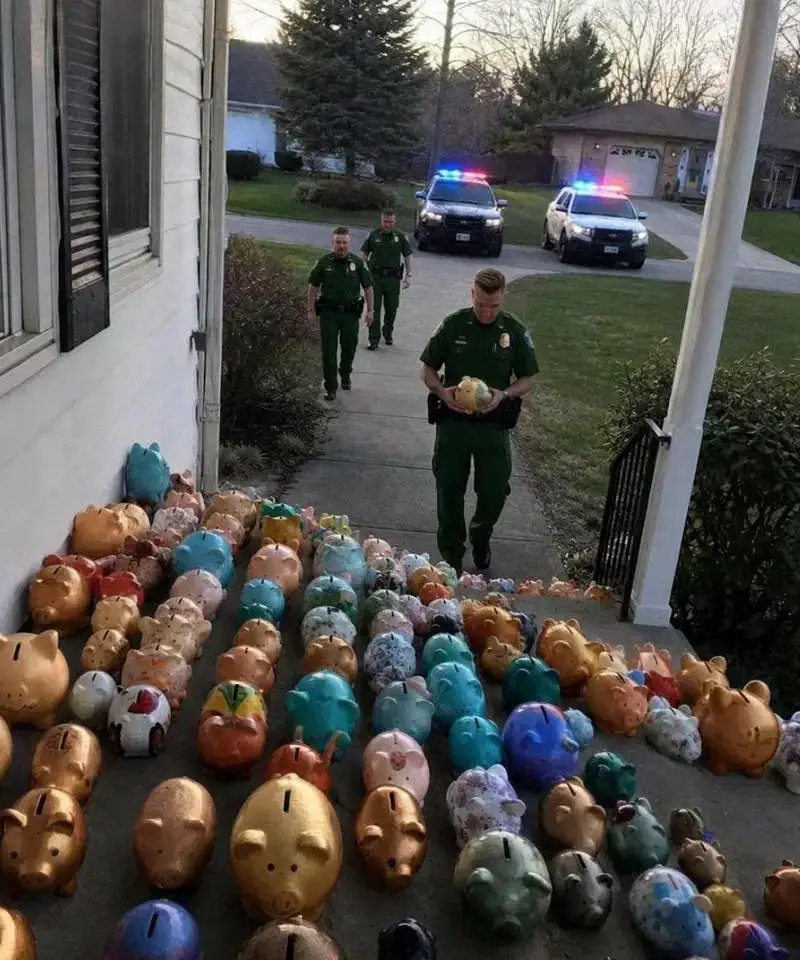
Instead, there was a police officer standing on my porch holding a red piggy bank.
Behind him?
Our entire front yard was covered with piggy banks.
Pink ones.
Blue ones.
Plastic ones.
Ceramic ones.
Dozens and dozens of them.
Police cars blocked the street while people carried more up the sidewalk.
Oliver peeked around my robe nervously.
“Mom… did I do something wrong?”
The officer smiled gently.
“No, buddy. You did something very right.”
Then he handed me the red piggy bank.
“Break it open,” he said.
Inside were handwritten notes, gift cards, checks, cash, and business cards.
One note read:
“Mrs. Adele paid for my lunch every Friday in third grade. I own a grocery store now. Her groceries are covered for the next year.”
Another:
“She told me I was too smart to learn on an empty stomach. Any home repairs are on me.”
And another:
“She made me feel seen when nobody else did.”
One by one, adults stepped forward crying as they shared stories about the woman who had quietly carried them through difficult childhoods.
A woman who never asked for recognition.
A woman most of us barely noticed anymore.
The Officer’s Secret
Then the police officer spoke again.
“I knew her name the second I saw the neighborhood post.”
He reached into his pocket and held up an old cafeteria token.
“She gave me this when I was seven years old,” he said softly. “She told me I could use it anytime I needed lunch but didn’t want to ask.”
Mrs. Adele stared at him in disbelief.
“Hayes?”
He nodded.
“You protected my dignity when I was a kid,” he said. “That’s why I became the kind of officer who checks on people.”
Nobody spoke for several seconds.
The entire street just stood there crying.
Because suddenly we all understood the same thing:
Kindness doesn’t disappear.
It multiplies.
Quietly.
Patiently.
Across years.
Across generations.
A Child Started It All
The most remarkable part?
None of this happened because of politicians.
Or charities.
Or viral influencers.
It started because a six-year-old boy noticed a dark porch light and refused to ignore it.
Children see things adults train themselves to overlook.
Loneliness.
Coldness.
Need.
Pain.
And unlike adults, children still believe helping is simple.
Maybe they’re right.
The Porch Light Came Back On
By afternoon, Mrs. Adele’s electricity was restored.
Neighbors repaired her home.
A local grocery store stocked her pantry.
Volunteers organized transportation and medical support.
Senior services helped fix her payment systems.
But the thing I remember most happened later that night.
I tucked Oliver into bed, and through his bedroom window we could see Mrs. Adele’s porch light glowing warmly again.
“Mom?” he whispered sleepily.
“Yeah, sweetheart?”
“She said I have your heart.”
I kissed his forehead.
“No,” I told him softly. “I think you reminded me how to use mine.”
Across the street, the porch light stayed on.
And somehow, something inside all of us stayed on too.
Because sometimes kindness doesn’t arrive loudly.
Sometimes it arrives in dinosaur pajamas carrying a piggy bank full of quarters.
And sometimes, that’s enough to light up an entire neighborhood.