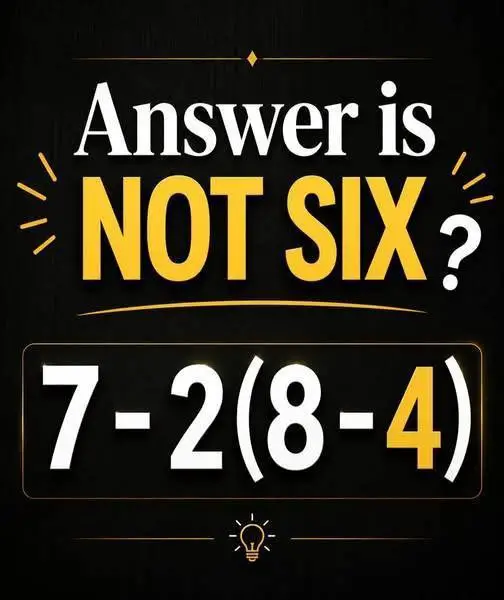
The Viral Math Trap That’s Breaking the Internet looks simple at first glance. That is exactly why it spreads so fast. A short equation appears on a black graphic, bold text declares that the answer is “not six,” and suddenly thousands of people argue in the comments.
The problem in the image is:
7 – 2(8 – 4)
At first, many people rush through it and land on the wrong answer. Others pause, apply the order of operations, and realize the expression is not as tricky as it looks. The real lesson goes beyond one number. It reminds us how easily our brains skip steps when something appears familiar.
I once saw a family dinner turn into a full math debate because someone shared a viral equation on their phone. Everyone felt certain at first. One person solved it mentally, another grabbed a calculator, and someone else started writing it on a napkin. Within minutes, laughter replaced frustration because the issue was not intelligence. It was speed. Everyone rushed. Once we slowed down and followed each step, the answer became obvious. That little moment made me realize why these puzzles spread so quickly. They challenge our confidence more than our math skills.
Why Viral Math Problems Catch So Many People
Viral math puzzles work because they look easy. However, that easy appearance often causes people to solve too quickly. When an equation seems simple, the brain wants to finish it fast instead of checking each rule carefully.
They Create Instant Confidence
A problem like 7 – 2(8 – 4) looks like something from elementary school. Because of that, most people assume they can solve it in seconds. Yet that confidence can become the trap.
The expression includes subtraction, multiplication, and parentheses. Those details matter. If someone reads the equation from left to right without applying order of operations, they may get a completely different answer.
For example, a rushed person might do:
7 – 2 = 5
8 – 4 = 4
5 × 4 = 20
That answer feels logical to them because they moved quickly from left to right. However, it ignores the correct order.
The proper method starts with parentheses:
8 – 4 = 4
Then the expression becomes:
7 – 2(4)
Since 2(4) means multiplication, solve that next:
2 × 4 = 8
Finally:
7 – 8 = -1
So the correct answer is -1.
They Turn Mistakes Into Arguments
These puzzles often go viral because people defend their first answer strongly. Once someone posts a confident response, changing their mind feels uncomfortable. Therefore, debates grow quickly.
Many online math traps are designed to create disagreement. The image may use bold wording like “Answer is not six?” because that phrase makes people curious. It also pressures viewers to prove they are smarter than the crowd.
However, the goal should not be winning an argument. Instead, the goal should be slowing down and understanding the process.
How Order of Operations Solves the Puzzle
The order of operations helps everyone read math expressions the same way. Without it, the same equation could produce several answers.
Parentheses Come First
In this problem, the parentheses are the key:
7 – 2(8 – 4)
The expression inside the parentheses must be solved before anything else.
8 – 4 = 4
Now the equation becomes:
7 – 2(4)
This step removes the biggest source of confusion. Once the parentheses are simplified, the rest becomes easier.
Multiplication Comes Before Subtraction
After parentheses, multiplication comes before subtraction.
So:
2(4) = 8
Then the expression becomes:
7 – 8
Now solve the final subtraction:
7 – 8 = -1
Therefore, the correct answer is -1.
This result surprises some people because they expected a positive number. However, math does not depend on expectation. It depends on structure.
Why “Not Six” Makes the Puzzle More Confusing
The image says, “Answer is NOT SIX?” That wording changes how people think before they even begin solving.
The Caption Plants a Doubt
When a puzzle tells you what the answer is not, your brain starts searching for a hidden trick. As a result, even a straightforward problem feels suspicious.
Some people may try too hard to find a complicated solution. Others may assume the puzzle must have a surprising answer. In reality, this expression only requires basic order of operations.
The phrase “not six” also creates curiosity. People want to know why six is wrong. That curiosity encourages comments, shares, and debate.
The Real Trap Is Rushing
This puzzle is not difficult. However, it punishes speed.
The common mistake happens when someone subtracts 2 from 7 before multiplying. But multiplication must happen before subtraction unless parentheses change the order.
So the correct sequence is:
- Solve 8 – 4
- Multiply 2 × 4
- Subtract 8 from 7
That gives -1.
Once written clearly, the answer becomes easy to see.
What This Puzzle Teaches About Clear Thinking
Viral math problems do more than test arithmetic. They reveal how people process information under pressure.
Slow Steps Beat Fast Guesses
Fast guesses feel satisfying, especially online. However, slow steps usually lead to better answers.
When solving any math expression, it helps to rewrite each step. This habit prevents skipped operations and reduces confusion.
For this problem:
7 – 2(8 – 4)
7 – 2(4)
7 – 8
-1
Each line follows clearly from the previous one.
Clear Notation Prevents Confusion
Some viral equations become controversial because they use unclear formatting. However, this specific expression is fairly clear.
The parentheses tell us exactly what to solve first. The number beside the parentheses tells us to multiply. Then subtraction finishes the expression.
Still, writing math neatly always helps. For example:
7 – [2 × (8 – 4)]
This version makes the multiplication easier to see and reduces careless mistakes.
Frequently Asked Questions
What is the correct answer to 7 – 2(8 – 4)?
The correct answer is -1.
Why is the answer not 6?
Because you must solve the parentheses first, then multiplication, and only then subtraction.
What does 2(8 – 4) mean?
It means 2 multiplied by the value inside the parentheses.
Why do people get different answers?
People often rush, skip the multiplication step, or incorrectly solve the expression strictly from left to right.
Is this a trick question?
Not really. It is a basic order-of-operations problem designed to look more confusing than it is.
Conclusion
The Viral Math Trap That’s Breaking the Internet proves how a simple equation can spark huge debate. The expression 7 – 2(8 – 4) looks easy, yet it catches people who move too quickly.
Once you apply the order of operations, the solution becomes clear:
8 – 4 = 4
2 × 4 = 8
7 – 8 = -1
So the answer is -1.
The bigger lesson is simple: slow down, follow each step, and do not let bold captions pressure you into rushing. Math rewards clarity, not speed.