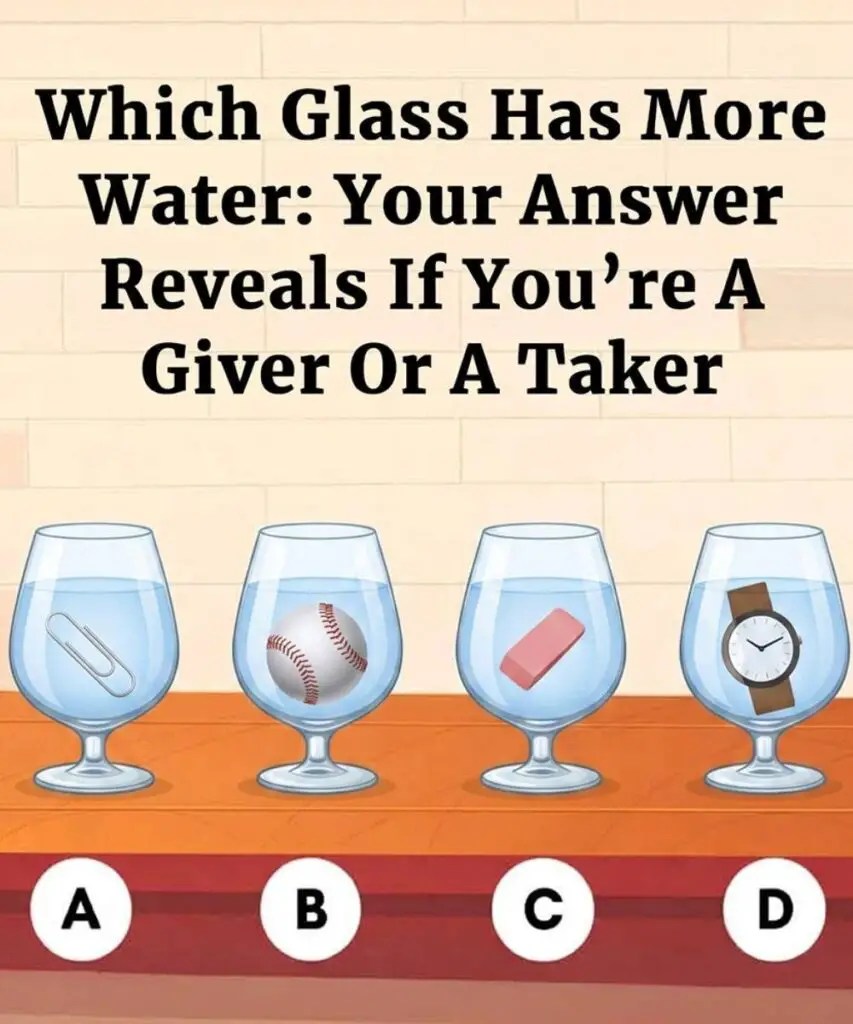
At first glance, this puzzle looks simple. Four glasses sit side by side. Each glass appears to have the same water level, but each one contains a different object. One has a paperclip, one has a baseball, one has an eraser, and one has a watch.
The question asks: which glass has more water?
Many people answer quickly because the water levels look almost equal. However, this puzzle is not just about what you see at first. It is about displacement, observation, and the way your brain handles small details.
The correct answer is usually Glass A, because the paperclip takes up the least space. Since all the water levels appear similar, the glass with the smallest object inside must contain the most actual water.
A woman once shared this puzzle during a family dinner. Everyone stared at the image and argued over the answer. One person chose the largest glass shape, another picked the floating object, and someone else said all glasses were equal. Then her grandfather calmly pointed to the smallest object and explained water displacement. The room went quiet, then everyone laughed. What seemed like a silly puzzle had reminded them that careful thinking often beats quick judgment.
How the Puzzle Works
The Objects Take Up Space
When an object sits inside a glass of water, it pushes some water aside. This is called displacement.
A larger object takes up more space, so less water is needed to reach the same visible level. A smaller object takes up less space, so more water remains inside the glass.
That is why the paperclip glass likely contains the most water.
The Water Level Can Be Misleading
The trick is that the water levels look similar. Your eyes focus on the surface line, but the real question asks about water volume.
Because each object occupies a different amount of space, the visible water level does not tell the full story.
Why Glass A Is the Best Answer
The Paperclip Displaces the Least Water
Glass A contains a paperclip. Compared with the baseball, eraser, and watch, the paperclip has the smallest volume.
That means it pushes aside the least water.
So, if all glasses are filled to about the same level, Glass A must hold more actual water than the others.
Larger Objects Reduce Water Volume
The baseball and watch take up much more room inside their glasses. Therefore, they reduce the amount of water needed to reach the same height.
This makes them less likely to contain the most water.
What Your Answer Might Say About How You Think
Quick Answer vs. Careful Answer
People who answer immediately may rely more on first impressions. That does not make them wrong in life, but it shows how easily visuals can guide decisions.
People who pause and compare the objects often notice the hidden clue.
Giver or Taker? Not Literally
The “giver or taker” idea is mostly for fun. A puzzle cannot truly measure someone’s personality.
However, it may reflect how someone approaches problems. Some people focus on the obvious. Others look deeper before deciding.
Why These Puzzles Go Viral
They Feel Simple but Create Debate
Visual puzzles spread quickly because everyone thinks they can solve them. Then, when answers differ, people become curious.
That small disagreement makes the puzzle entertaining.
They Teach a Real Concept
This puzzle also teaches a basic science idea in a memorable way.
Water displacement explains why objects appear to change liquid levels, why boats float, and why measuring volume can require more than just looking.
Common Mistakes People Make
Choosing the Glass With the Highest Water Line
Some people look only at the visible water level. However, the object inside changes the meaning of that level.
Assuming All Glasses Hold Equal Water
Even if the water lines match, the actual water amount changes because the objects have different sizes.
Overthinking the Floating Object
Floating objects displace water differently than fully submerged objects. Still, in this image, the simplest answer remains the glass with the smallest object.
Frequently Asked Questions
Which glass has the most water?
Glass A most likely has the most water because the paperclip displaces the least space.
Why not the glass with the biggest object?
A bigger object takes up more room, leaving less space for water.
Is this really a personality test?
No. It is mainly a logic puzzle with a playful personality twist.
What is displacement?
Displacement happens when an object pushes liquid aside by occupying space.
Why do people get this puzzle wrong?
Most people focus on the water line instead of the object volume.
Conclusion
The answer to the puzzle is most likely Glass A. The paperclip takes up the least space, so that glass contains the most actual water if all water levels appear equal.
This puzzle works because it challenges first impressions. It reminds us that what looks obvious is not always complete.
Sometimes the smallest detail changes the entire answer.