
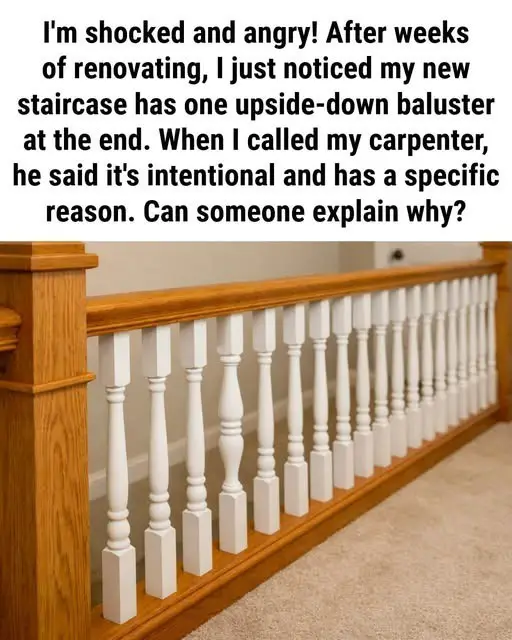
The Upside-Down Baluster — Craftsmanship, Humility, and the Myth of “Intentional Imperfection” reveals how even the smallest architectural detail can spark deep reflection. At first glance, an upside-down baluster may look like a mistake. However, it often invites a broader conversation about craftsmanship, human error, and the stories embedded in the built environment. Rather than dismissing it as a flaw, many people see it as a reminder that perfection is not always the ultimate goal.
In architecture and woodworking, every element carries intention, whether deliberate or accidental. The upside-down baluster sits at the intersection of precision and imperfection, raising questions about what we value in design and craftsmanship.
I remember walking through an old building and noticing a single baluster that seemed out of place. At first, I thought it was a careless error. However, the longer I looked, the more it felt intentional—as if it carried a quiet message. That moment changed how I saw imperfections, not as flaws but as subtle signatures of the human hand.
The Craftsmanship Behind Every Baluster
The Art of Traditional Woodworking
A baluster may appear simple, yet it requires careful shaping, sanding, and finishing. Craftspeople often spend hours refining each piece to ensure consistency and structural integrity.
However, woodworking is not purely mechanical. Variations in wood grain, density, and moisture can influence the final result. Even with skill and precision, slight differences naturally occur.
Because of this, no two balusters are ever truly identical. These subtle differences add character and authenticity to handcrafted work.
Human Touch in Every Detail
Unlike mass-produced items, handcrafted elements reflect the presence of the maker. Small irregularities can serve as evidence of human involvement.
In fact, many artisans embrace these imperfections as part of the creative process. They see them not as errors, but as proof that the work was shaped by real hands rather than machines.
Therefore, an upside-down baluster may not simply be a mistake—it may represent the unpredictability that comes with human craftsmanship.
Mistake or Meaning? Understanding the Anomaly
When Errors Become Stories
At times, an upside-down baluster is simply an installation error. Even skilled workers can make mistakes, especially in large projects with repetitive tasks.
However, once noticed, these “mistakes” often take on new meaning. They become conversation pieces, drawing attention and curiosity.
People begin to ask questions: Was it intentional? Was it overlooked? Why was it left that way?
Because of this, the anomaly transforms into a story embedded within the structure.
The Idea of Intentional Imperfection
Some traditions embrace the concept of intentional imperfection. The idea suggests that leaving a flaw acknowledges human limitations and avoids the illusion of perfection.
In certain cultural philosophies, perfection is reserved for something greater than human creation. Therefore, a deliberate flaw becomes a symbol of humility.
Although not every upside-down baluster is intentional, the idea resonates with many who encounter it.
The Symbolism of Imperfection
A Reminder of Humanity
An upside-down baluster can serve as a subtle reminder that all human work is inherently imperfect. Even in highly skilled craftsmanship, complete perfection remains elusive.
This perspective shifts how we view flaws. Instead of seeing them as failures, we begin to recognize them as part of the creative process.
As a result, imperfections can feel more authentic and meaningful.
Challenging Modern Expectations
In today’s world, many people expect flawless results, especially with advanced technology and manufacturing.
However, this expectation can sometimes remove the character and individuality from objects. Perfect uniformity often lacks the warmth of handmade work.
By contrast, a small imperfection—like an upside-down baluster—can reintroduce personality and depth into a space.
Craftsmanship, Humility, and Perspective
Lessons from a Small Detail
The upside-down baluster teaches a valuable lesson about perspective. What appears to be a flaw may actually hold deeper meaning.
It encourages us to slow down, observe, and reflect rather than judge immediately. In doing so, we gain a greater appreciation for the work and the people behind it.
This shift in perspective can extend beyond architecture into everyday life.
Embracing Imperfection in a Perfect World
Ultimately, the idea of intentional imperfection invites us to reconsider our standards. Instead of striving for unattainable perfection, we can value authenticity and effort.
This approach fosters humility, both in creators and observers. It reminds us that beauty often lies in subtle irregularities.
Because of this, the upside-down baluster becomes more than just a design anomaly—it becomes a quiet symbol of humanity.
Frequently Asked Questions
1. Is an upside-down baluster always intentional?
No, it can be either an installation mistake or, in some cases, a deliberate design choice.
2. Why would someone leave a visible flaw?
Some traditions value imperfection as a symbol of humility and authenticity.
3. Does it affect structural integrity?
Typically, it does not impact function if installed securely.
4. Is intentional imperfection common in design?
It appears in various cultural and artistic traditions, though not always in architecture.
5. Should it be corrected if found?
That depends on the context—some prefer to fix it, while others appreciate its uniqueness.
Conclusion
The Upside-Down Baluster — Craftsmanship, Humility, and the Myth of “Intentional Imperfection” shows how even the smallest detail can carry significant meaning. Whether it is a simple mistake or a deliberate choice, it challenges our understanding of perfection and craftsmanship.
Rather than seeing flaws as something to eliminate, we can begin to view them as part of a larger story. In doing so, we gain a deeper appreciation for the human element in design.
In the end, the upside-down baluster stands as a quiet reminder that imperfection is not something to hide—it is something to understand, and sometimes, even to celebrate.