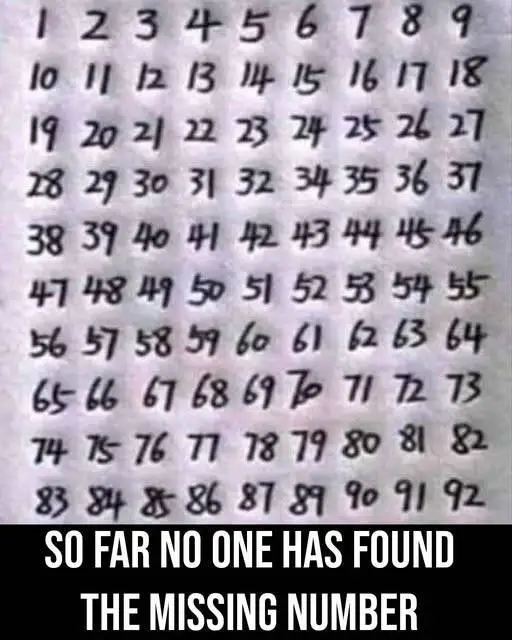
At first glance, a simple number grid looks almost impossible to get wrong. Most people immediately assume they’ll spot the missing number within seconds. Yet surprisingly, many stare at the puzzle repeatedly before finally noticing what’s missing.
That frustration is exactly what makes these brain teasers so fascinating.
In this particular puzzle, the missing numbers are:
- 33
- 88
Even after learning the answer, many people still struggle to spot them immediately when looking back at the grid. That happens because the human brain is designed to recognize patterns quickly rather than inspect every tiny detail carefully.
A teacher once gave this exact puzzle to her classroom expecting students to solve it instantly. Instead, nearly everyone confidently claimed the grid was complete. Once the missing numbers were revealed, the room erupted with disbelief and laughter. The students weren’t careless — their brains were simply doing what human brains naturally do every day: filling in expected information automatically.
Why the Brain Misses Obvious Errors
Pattern Recognition Happens Automatically
The human brain constantly searches for patterns to process information faster.
When people look at a sequence like:
1, 2, 3, 4, 5…
the brain quickly predicts what comes next without carefully analyzing every single number.
That efficiency helps people:
- Read faster
- Recognize faces
- Drive cars
- Understand language
- Navigate familiar places
Without pattern recognition, everyday life would feel mentally exhausting.
However, puzzles exploit this mental shortcut beautifully.
When the eyes move from:
32 → 34
the brain unconsciously inserts:
“33”
even though it never actually appeared.
The same thing happens with:
87 → 89
because the brain expects continuity.
The Brain Prioritizes Speed Over Accuracy
The brain consumes enormous energy every day. To conserve mental effort, it uses shortcuts called cognitive heuristics.
Instead of checking every tiny detail individually, the brain asks:
“Does this overall pattern look normal?”
If the answer feels like “yes,” attention decreases dramatically.
This mental efficiency usually helps people function faster and more effectively. But in visual puzzles, that shortcut becomes a weakness.
Brain teasers succeed because they manipulate expectation.
Cognitive Biases Behind Number Puzzles
Inattentional Blindness
One important psychological effect involved here is called inattentional blindness.
This occurs when:
- Attention focuses on one pattern
- The brain overlooks unexpected details
- Obvious information becomes temporarily invisible
People often assume seeing equals noticing.
In reality, the brain filters enormous amounts of visual information constantly.
That filtering process explains why people can:
- Miss typos
- Overlook missing objects
- Forget visible details
- Ignore changes in familiar environments
The missing numbers are technically visible through their absence — but the brain mentally “fills the gaps” automatically.
Familiar Sequences Lower Attention
Repeated sequences reduce mental alertness because predictability creates comfort.
Once the first few rows appear correct, most people stop carefully reading.
Instead, they begin:
- Scanning quickly
- Assuming consistency
- Trusting the pattern
That relaxed attention allows missing details to hide in plain sight.
Ironically, the easier a task appears, the less carefully people examine it.
Why Viral Brain Teasers Feel So Addictive
Curiosity and Frustration Create Mental Tension
Puzzles like this generate a unique kind of psychological tension.
The brain believes:
“This should be easy.”
But the answer remains hidden longer than expected.
That mismatch between expectation and difficulty triggers curiosity and frustration simultaneously.
People keep searching because the brain dislikes unresolved uncertainty.
Once the answer appears, the mind experiences a satisfying release of tension — which explains why solving puzzles often feels rewarding.
Social Sharing Amplifies the Effect
Online brain teasers spread rapidly because they trigger emotional reactions:
- Surprise
- Embarrassment
- Curiosity
- Competition
- Satisfaction
People enjoy testing friends and family because everyone assumes they’ll solve the puzzle quickly.
Watching others struggle creates humor and fascination.
The simplicity of the puzzle actually makes it more effective.
What These Puzzles Reveal About Human Thinking
Seeing and Noticing Are Different Processes
One major lesson from puzzles like this is that seeing something physically does not guarantee conscious awareness.
Vision involves:
- Eyes collecting information
- The brain interpreting patterns
- Attention deciding what matters
People do not perceive reality exactly as it exists. Instead, the brain constructs an efficient interpretation of reality based partly on expectations.
That system works remarkably well most of the time.
But occasionally, it causes people to overlook surprisingly obvious details.
Intelligence Does Not Prevent Mistakes
Many people assume only distracted or unintelligent individuals miss these puzzles.
Actually, highly intelligent people often miss them too.
Why?
Because intelligence frequently increases pattern recognition speed, making the brain even more likely to:
- Auto-complete sequences
- Trust expectations
- Skip repetitive verification
The puzzle exploits efficiency rather than lack of intelligence.
How Brain Teasers May Benefit the Mind
Mental Exercises Encourage Focus
Although brain teasers are mostly entertainment, they may help strengthen:
- Attention to detail
- Concentration
- Visual scanning
- Problem-solving
- Cognitive flexibility
Puzzles force the brain to slow down and question assumptions.
That kind of mental exercise can feel refreshing because daily life often encourages fast automatic thinking instead.
Curiosity Keeps the Brain Active
Activities involving curiosity and problem-solving stimulate mental engagement.
Many people enjoy:
- Logic puzzles
- Crosswords
- Sudoku
- Visual riddles
- Memory games
These activities challenge the brain to think differently and remain mentally active.
Even simple puzzles can encourage people to become more observant in everyday situations.
Frequently Asked Questions
What numbers are missing in the puzzle?
The missing numbers are 33 and 88.
Why do people overlook obvious mistakes?
The brain automatically fills expected patterns instead of carefully checking every detail.
What is pattern completion?
Pattern completion occurs when the brain predicts missing information based on familiar sequences.
Does everyone experience this effect?
Yes. Pattern recognition and mental shortcuts are normal human cognitive processes.
Can puzzles improve attention skills?
Brain teasers may help strengthen focus, observation, and cognitive flexibility over time.
Final Thoughts
This missing number puzzle feels difficult not because the answer is hidden well, but because the human brain is extremely efficient at recognizing patterns and filling gaps automatically.
The same mental shortcuts that help people read quickly, recognize familiar faces, and process information efficiently can also cause obvious details to disappear right in front of them.
In a strange way, these puzzles reveal something fascinating about human perception:
people often see not only what is present, but also what they expect to see.
And once the missing numbers finally become obvious, most people immediately wonder how they missed them for so long in the first place.
More Home Remedies
- Wrinkled Fingers After Water Exposure: What Your Skin May Be Telling You
- Skin Rash With Breathing Trouble? It Could Be a Life-Threatening Allergic Reaction
- I Thought It Was a Piece of Trash on the Bathroom Floor—Until It Moved
- If You Are Getting White Pimples on Your Lips or Intimate Area, Here’s What They Could Mean