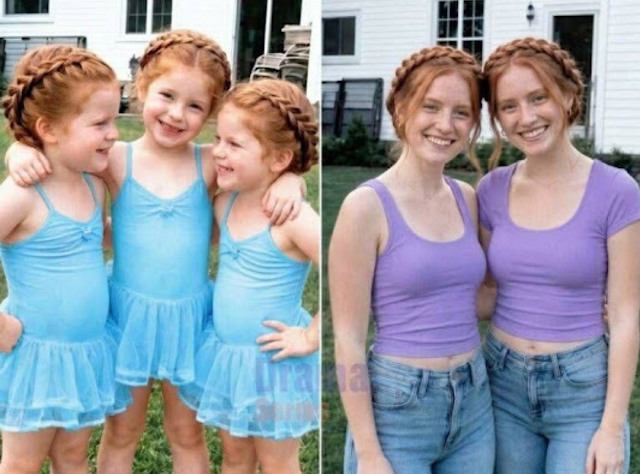
There were once three of us.
Leila.
Nora.
And me.
People often say that time heals every wound. I wish that were true. In my experience, grief doesn’t disappear—it simply changes shape. It becomes quieter. It settles into everyday life until you almost forget it’s there, only to rise again with a familiar song, an old photograph, or an empty chair at the dinner table.
When Nora died, the world slowly rewrote our story.
Neighbors began calling Leila and me “the twins.” Teachers introduced us that way. Friends who met us later never questioned it. Explaining that we had once been triplets always changed the atmosphere. Conversations stopped. Faces fell. People searched for the right words and usually found none.
Eventually, we stopped correcting them.
It was easier for everyone else.
Maybe it was easier for us, too.
Because as long as we never said there had been three of us, we could pretend the story hadn’t really ended.
But every birthday reminded us otherwise.
Three Sisters Who Were Never Quite the Same
Although we shared the same birthday, we couldn’t have been more different.
Leila entered the world first, confidently announcing herself four minutes before anyone else.
Nora followed two minutes later.
I arrived last, forever earning the nickname “the baby.”
Leila was organized before any of us even understood what organization meant. She lined up her toys perfectly and planned games with military precision.
I was emotional. If someone cried, I cried. If someone laughed, I laughed harder.
Nora somehow balanced us both.
She knew exactly how to calm Leila when she became frustrated.
She knew exactly how to comfort me whenever I became overwhelmed.
She was only eleven years old, yet she somehow carried the emotional wisdom of someone much older.
If Leila and I argued, Nora always stood between us.
“We’re sisters,” she’d say.
“Sisters help each other.”
Those simple words became the foundation of our childhood.
The Day Everything Changed
Then one ordinary illness became something extraordinary.
Doctors called it a rare complication.
Our parents called it impossible.
We simply called it unfair.
One evening, Leila and I waited at home believing Nora would soon return from the hospital.
Instead, our parents sat us down in the living room.
I remember almost nothing they said.
Only fragments.
“…did everything they could…”
“…so sorry…”
“…she isn’t coming home…”
Everything after that became blurred by tears.
I remember screaming until my throat hurt.
I remember my father crying for the first time in my life.
I remember my mother’s hands shaking.
Mostly, I remember Leila squeezing my hand so tightly that her fingernails left tiny crescent marks in my skin.
She never let go.
Learning to Grow Up Without Her
The funeral took place on a cold, rainy Tuesday.
The weather seemed to understand what none of us could express.
Rain soaked the flowers.
Mud clung to our shoes.
People hugged us while saying words they hoped would help.
Nothing helped.
When the service ended, I looked toward the cemetery gate expecting Nora to appear somehow, laughing because everyone had misunderstood.
Children believe impossible things.
Sometimes adults do too.
Afterward, life resumed for everyone else.
School reopened.
Neighbors returned to work.
Friends talked about homework and birthdays and summer vacation.
Meanwhile, our family quietly learned how to exist with one chair permanently empty.
Two Sisters Carrying the Same Grief in Different Ways
Looking back now, I realize Leila and I responded to loss in completely opposite directions.
Leila became quieter.
She rarely cried where anyone could see.
She focused on school, responsibilities, and protecting me.
She tried to become the older sister she believed Nora would have wanted.
I did the opposite.
I talked about Nora constantly.
I wore the colorful bracelet she had made for my ninth birthday until the string nearly broke apart.
I told stories about her whenever anyone would listen.
Sometimes people smiled politely.
Sometimes they changed the subject.
Sometimes they looked uncomfortable.
I didn’t care.
As long as someone remembered Nora’s name, part of her still felt alive.
Unfortunately, our different coping styles slowly pulled us apart.
Instead of grieving together, we grieved alone.
Neither of us realized how lonely the other had become.
A House That Refused to Forget
Leila eventually left for college earlier than expected.
She said she needed a fresh start.
I understood.
Every room inside our house carried memories.
The hallway still echoed with three pairs of footsteps.
Our bedroom still held tiny reminders of childhood.
A forgotten hair ribbon.
A faded stuffed rabbit.
An old photograph tucked inside a dresser drawer.
I stayed.
Leaving felt like abandoning the only place where Nora had ever existed.
Years passed.
Birthdays became quieter.
Christmases became smaller.
Our family learned to function again, but none of us ever truly healed.
We simply became experts at pretending.
None of us realized that our mother had been quietly protecting one final gift.
A gift she believed we would only understand when we were finally old enough to receive it.
That moment arrived on our twenty-first birthday.
The Box We Had Waited Ten Years to Open
On our twenty-first birthday, our mother asked Leila and me to come home.
It wasn’t unusual for us to celebrate together, but something about that afternoon felt different. Mom seemed nervous. She had prepared our favorite meal, yet barely touched her own plate. After dinner she disappeared into her bedroom and returned carrying a small wooden box.
It wasn’t large—about the size of an old shoebox—but it looked surprisingly heavy in her hands.
The brass clasp had tarnished with age, and faint scratches covered the dark wood, as though it had been opened and closed many times before finally being tucked away.
She placed it gently on the coffee table.
Neither of us spoke.
“I’ve been keeping this for ten years,” she finally whispered.
“It belonged to Nora.”
The room fell silent.
I could hear nothing except the ticking clock on the wall.
Mom rested both hands on the lid before looking up at us.
“I promised myself I wouldn’t give it to you until you were old enough to understand it.”
Leila looked at me.
Neither of us knew what to expect.
Family photographs?
Childhood drawings?
Maybe one of Nora’s favorite toys.
Instead, Mom nodded toward the box.
“It’s time.”
A Treasure Filled With Words
My hands trembled as I lifted the brass latch.
Inside were dozens of neatly folded envelopes.
Each one had a name written across the front in Nora’s unmistakable handwriting.
One for Mom.
One for Dad.
Several for Leila.
Several for me.
One addressed to both of us together.
Beneath the letters rested a worn journal tied with a faded blue ribbon.
The pages looked soft from years of handling.
It smelled faintly of old paper and lavender.
Mom smiled through tears.
“I found all of this in Nora’s closet after she passed away.”
“I couldn’t bring myself to read everything.”
“I believed these belonged to you.”
The Letter That Changed Everything
Leila carefully picked up the envelope addressed to both of us.
We opened it together.
The first sentence stole the air from the room.
Dear Leila and Elle,
If you’re reading this, I’m not there anymore.
I stopped breathing.
Every word felt impossibly alive.
It sounded exactly like Nora.
Warm.
Gentle.
Comforting.
She explained that she hadn’t wanted us to be frightened by her illness.
She wrote that she hoped we’d remember her laughter instead of hospital rooms.
Then she spoke directly to each of us.
To Leila, she wrote:
“You always think you have to be the strong one. You don’t have to carry everyone by yourself.”
To me, she wrote:
“You keep holding onto my memory because you’re afraid letting go means losing me. It doesn’t. Love stays even when pain begins to fade.”
By the time we reached the final paragraph, neither of us could see through our tears.
She ended with one request.
“Promise me you won’t let my death become bigger than my life.”
It was such a simple sentence.
Yet it felt like something neither of us had ever truly understood.
Reading the Journal
The journal revealed an entirely different side of Nora.
She wasn’t writing about being sick.
She was writing about us.
One page described Leila teaching us multiplication.
Another remembered the time I fell off my bicycle and refused to let anyone except Nora put a bandage on my knee.
Some entries made us laugh.
Others completely broke our hearts.
She noticed things we never realized.
“Elle laughs with her whole body.”
“Leila pretends she’s fearless, but she worries about everyone.”
“I hope they never forget how funny they are together.”
As I continued reading aloud, Leila quietly wiped away tears she had spent ten years refusing to show anyone.
For the first time since we were children, we cried together instead of separately.
It felt as though Nora had somehow reunited us across an entire decade.
A Name We Had Never Heard Before
Near the final pages, something unexpected appeared.
Another sealed envelope.
Unlike the others, it wasn’t addressed to family.
Written neatly across the front was a single name.
Tessa.
Leila frowned.
“Who’s Tessa?”
I shook my head.
“I’ve never heard Mom mention anyone by that name.”
We searched through the journal.
Nora mentioned Tessa only briefly.
She wrote that she hoped one day we would understand why this person mattered.
Nothing more.
No explanation.
No clues.
Just a name.
When we looked up, our mother seemed equally surprised.
“I’ve never opened that letter,” she admitted.
“I always believed it wasn’t mine to read.”
For the first time that evening, our sadness was joined by curiosity.
Who was Tessa?
Why had Nora written to her?
And why had she never told us about her?
As the night grew late, Leila and I realized something remarkable had happened.
We hadn’t just opened a box.
We had opened a conversation that grief had stolen from us ten years earlier.
And although we still had countless unanswered questions, we finally faced them together instead of alone.
A Night That Changed Our Family Forever
Neither of us slept much that night.
The journal lay open on the kitchen table while cups of untouched tea slowly grew cold beside it. Every few minutes one of us would flip back through the pages, rereading another memory, another observation, another reminder that Nora had seen us more clearly than we had ever seen ourselves.
It felt as though she had reached across ten years and gently taken both of our hands.
Eventually, Leila broke the silence.
“I’ve been angry at her.”
I looked up.
She stared at the journal without lifting her eyes.
“I was angry that she left.”
It was the first time I had ever heard my sister admit it aloud.
“I know she didn’t choose it,” she continued quietly. “But I was angry anyway. Every time I thought about her, I felt guilty for feeling angry, so I stopped thinking about her altogether.”
Her words explained ten years of distance.
Ten years of avoiding photographs.
Ten years of changing the subject whenever Nora’s name came up.
I reached across the table and took her hand.
“I thought you wanted to forget her.”
Leila shook her head.
“No.”
“I just didn’t know how to remember her without breaking.”
For a long moment neither of us spoke.
Then, for the first time since we were eleven years old, we cried in each other’s arms instead of in separate rooms.
Asking Mom About Tessa
The next morning we carried the mysterious envelope into the kitchen where our mother was quietly watering the plants by the window.
She looked at the name on the front and sighed.
“I wondered when you’d ask.”
“You know who she is?” Leila asked.
Mom nodded slowly.
“Tessa wasn’t family.”
“She was Nora’s roommate during one of her hospital stays.”
We stared at her.
“Nora never told us because she didn’t want you worrying about how often she was there.”
Mom explained that during several hospital visits, Nora had become close friends with another young girl battling a serious illness.
They spent hours drawing pictures, telling jokes, and dreaming about what they would do when they both got better.
“Nora adored her,” Mom said softly.
“They promised they’d write each other letters.”
Tessa eventually moved to another treatment center.
The girls lost touch.
When Nora realized she might not recover, she wrote one final letter, hoping someone would one day deliver it.
Our mother never knew how to find her.
She kept the envelope safely inside the wooden box, believing that perhaps one day the opportunity would come.
More Than Letters
Over the following weeks, Leila and I read every page of Nora’s journal.
Some entries were heartbreaking.
Others were unexpectedly funny.
She had written lists of our favorite foods.
She described family vacations.
She complained about homework.
She even predicted that Leila would become “the organized adult” while I would always be “the emotional one.”
She was right about both.
We laughed more than we expected.
For years, every memory of Nora had been connected to hospitals and funerals.
Now those painful images slowly gave way to memories of pillow forts, birthday cakes, inside jokes, and whispered conversations after bedtime.
Her journal reminded us that her life was much bigger than the day it ended.
Learning That Love Doesn’t End
One afternoon I asked Mom why she had waited until our twenty-first birthday.
She smiled through quiet tears.
“Because grief changes as you grow.”
“When you were children, you needed protection.”
“As adults, you needed understanding.”
She was right.
At eleven, we would have clung to those letters as proof that Nora was gone.
At twenty-one, we finally understood they were proof that her love had never left.
That realization changed something inside all three of us.
Instead of visiting the cemetery only on anniversaries, we began sharing stories throughout the year.
Instead of avoiding old photographs, we framed them.
Instead of pretending there had only been two sisters, we gently corrected people.
“There were actually three of us.”
Saying it still hurt.
But now it also made us smile.
Frequently Asked Questions
Does grief ever completely disappear?
Grief rarely disappears entirely. For many people, it changes over time. The sharp pain often softens, making room for gratitude, remembrance, and love alongside sadness.
Why did the sisters grieve so differently?
Everyone processes loss in their own way. One sister coped by holding tightly to memories, while the other tried to protect herself by avoiding them. Neither approach was wrong—they were simply different responses to the same heartbreak.
Why were the letters so healing?
The letters gave voice to feelings that had remained unspoken for years. They reminded the sisters that they were deeply loved and encouraged them to reconnect instead of carrying their grief alone.
What can families learn from this story?
Open conversations about grief are important. Sharing memories, expressing emotions, and allowing each person to mourn differently can strengthen relationships rather than divide them.
Why did the mystery of Tessa matter?
Tessa represented the parts of Nora’s life her family never knew. The letter reminded them that every person touches many lives, and every relationship leaves its own lasting legacy.
A Final Thought
Losing Nora changed our family forever.
For years we believed grief had stolen our sister from us a second time by taking away the conversations we were too afraid to have. We carried the same loss but walked separate paths, believing we were protecting each other when we were really protecting ourselves from more pain.
The wooden box changed that.
Inside were not just letters and journal pages, but permission to remember, permission to cry, permission to laugh again, and permission to keep loving someone who was no longer physically present.
Today, when someone asks whether I have siblings, I no longer hesitate.
“I have two sisters,” I tell them.
“One is beside me.”
“And one is always with me.”
Because love doesn’t end with goodbye.
It continues in the stories we tell, the memories we protect, the kindness we pass on, and the people we choose to hold close.
Nora may have left us when we were only eleven years old.
But through her words, she helped bring our family back together ten years later.
Sometimes the greatest gift a loved one leaves behind isn’t an inheritance.
It’s the reminder that even after unimaginable loss, love still knows the way home