At first glance, this riddle appears completely impossible.
A woman was born in 1975.
She died in 1975.
Yet she was 22 years old when she died.
How could that possibly be true?
Most people read the statement once, frown, and immediately assume there’s a mistake. Others begin searching for complicated explanations involving leap years, unusual calendars, time travel, or hidden mathematical tricks.
But the beauty of this classic brain teaser is that none of those explanations are necessary.
The answer is surprisingly simple.
And that’s exactly why so many people get it wrong.
This riddle has puzzled generations of puzzle lovers because it exploits one of the most common habits of the human mind: making assumptions without realizing we’re making them.
Let’s explore why this riddle is so clever, what it teaches us about human thinking, and why puzzles like this remain popular all over the world.
The Riddle
Let’s start with the exact wording:
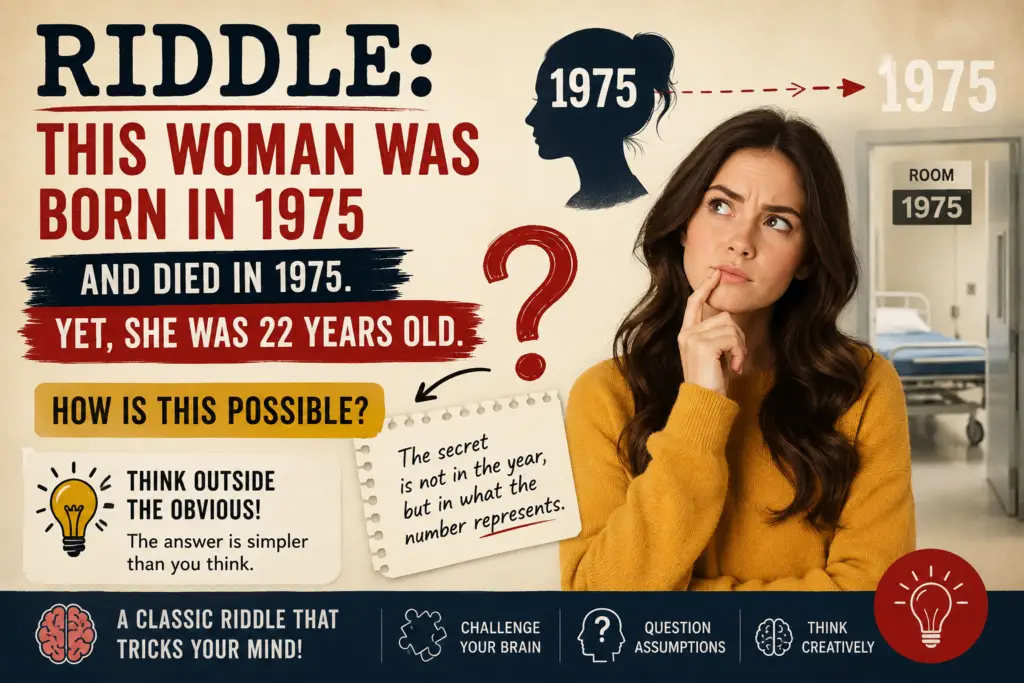
A woman was born in 1975 and died in 1975. She was 22 years old when she died. How is this possible?
Take a moment before continuing.
Try to solve it yourself.
What is your first thought?
Most people immediately focus on the number 1975.
And that’s exactly where the trap begins.
Why the Riddle Feels Impossible
The statement seems to violate basic logic.
If someone was born in 1975 and died in 1975, then they could not have lived longer than a year.
Yet the riddle clearly states that she was 22 years old.
The contradiction appears obvious.
As a result, the brain immediately starts searching for complicated solutions.
Some common guesses include:
- A typo in the dates
- Different calendar systems
- A leap-year trick
- Time travel
- Adoption records
- Historical errors
Interestingly, nearly all of these guesses share the same mistake.
They assume that 1975 is a year.
But does the riddle ever actually say that?
No.
That’s the hidden trick.
The Power of Assumptions
Human beings are remarkable pattern-recognition machines.
Our brains constantly make predictions based on previous experiences.
This ability helps us function efficiently.
Without it, even simple daily tasks would become exhausting.
However, these mental shortcuts sometimes work against us.
When we see a four-digit number placed near words like “born” and “died,” our minds automatically label it as a year.
We don’t consciously choose that interpretation.
Our brains simply do it.
The riddle exploits this automatic response.
The wording encourages us to jump to a conclusion before examining all possibilities.
The Correct Answer
The solution is surprisingly simple.
1975 was not a year.
It was a room number.
The woman was born in hospital room 1975.
Twenty-two years later, she died in hospital room 1975.
Once you recognize that 1975 does not have to represent a date, the entire puzzle suddenly makes perfect sense.
Nothing impossible happened.
No time travel was involved.
No mathematical tricks were necessary.
The problem existed only because of an assumption.
Why People Love This Riddle
This puzzle has remained popular for decades because it creates a satisfying moment of realization.
Psychologists sometimes refer to this as an “aha moment.”
It’s the instant when a confusing situation suddenly becomes clear.
The brain enjoys these moments because they reward creative thinking.
When we solve a puzzle that challenges our assumptions, we experience a sense of accomplishment.
That’s one reason riddles have survived for thousands of years across different cultures.
They entertain us while also teaching valuable lessons about thinking.
What This Puzzle Reveals About Human Psychology
The 1975 riddle demonstrates several fascinating psychological principles.
1. Assumption Bias
Assumption bias occurs when we accept information without questioning it.
In this case, we automatically assume 1975 represents a year.
The riddle never says that.
Our minds simply fill in the missing information.
This happens constantly in everyday life.
People often make decisions based on assumptions they never stop to examine.
2. Functional Fixedness
Functional fixedness describes our tendency to view things only in familiar ways.
When we see a number that resembles a year, we immediately treat it as a year.
We struggle to imagine alternative possibilities.
The riddle forces us to break free from that limitation.
3. Cognitive Shortcuts
Our brains rely on shortcuts to process information quickly.
Most of the time, these shortcuts are helpful.
However, puzzles like this expose situations where shortcuts can lead us astray.
4. Perspective Shifts
The solution requires changing perspectives.
Instead of asking, “How can someone be born and die in the same year?” we must ask, “What if 1975 isn’t a year?”
That small shift changes everything.
The History of Brain Teasers
Riddles have existed for thousands of years.
Ancient civilizations used them for entertainment, education, and even spiritual instruction.
In Ancient Greece, riddles were popular at gatherings and philosophical discussions.
In many cultures, solving riddles demonstrated wisdom and intelligence.
One of the most famous examples is the riddle of the Sphinx from Greek mythology:
“What walks on four legs in the morning, two legs at noon, and three legs in the evening?”
The answer, of course, is a human being.
As a baby, a person crawls on four limbs.
As an adult, they walk on two legs.
In old age, they may use a cane as a third support.
Like the 1975 riddle, the Sphinx’s puzzle relies on changing perspective.
Why Brain Teasers Are Good for You
Many people think puzzles are simply entertainment.
However, research suggests they may offer genuine cognitive benefits.
Improved Critical Thinking
Brain teasers encourage us to evaluate information carefully.
Instead of accepting assumptions, we learn to question them.
Better Problem-Solving Skills
Many real-life challenges require creative thinking.
Puzzles train the mind to consider multiple possibilities.
Increased Mental Flexibility
The ability to shift perspectives is valuable in work, relationships, and everyday decision-making.
Enhanced Memory
Regular mental exercise helps keep the brain active and engaged.
Improved Concentration
Solving puzzles requires focus and attention to detail.
Over time, this can strengthen concentration skills.
Other Classic Riddles That Trick Assumptions
The 1975 puzzle belongs to a family of riddles that exploit hidden assumptions.
Here are a few famous examples.
The Doctor Riddle
A father and son are involved in a car accident.
The father dies.
The son is rushed to the hospital.
The surgeon looks at the boy and says:
“I can’t operate on him. He’s my son.”
How is this possible?
Many people struggle because they unconsciously assume the surgeon is male.
The answer is simple:
The surgeon is the boy’s mother.
The Two Coins Puzzle
I have two coins that total 30 cents.
One of them is not a nickel.
What are the coins?
Most people assume neither coin can be a nickel.
But the riddle only says one coin is not a nickel.
The other one can be.
Answer:
A quarter and a nickel.
The Widow’s Sister
Can a man legally marry his widow’s sister?
No.
Because he is already dead.
Again, the trick lies in assumptions.
Lessons We Can Apply to Everyday Life
The 1975 riddle isn’t just a fun mental exercise.
It offers useful lessons for real life.
Question First Impressions
Our initial interpretation is not always correct.
Taking a second look often reveals new possibilities.
Don’t Assume Missing Information
People frequently fill in blanks based on personal expectations.
This can lead to misunderstandings.
Stay Curious
Curiosity helps us discover alternative explanations and solutions.
Think Creatively
Many problems become easier when viewed from a different angle.
Be Open-Minded
Sometimes the answer isn’t hidden in complexity.
It’s hidden in simplicity.
Why Viral Riddles Spread So Quickly
In the age of social media, riddles like this spread rapidly.
There are several reasons for their popularity.
First, they’re short and easy to share.
Second, they create emotional reactions.
People enjoy testing themselves.
Third, the surprising answer encourages conversation.
When someone discovers the solution, they often want to challenge friends and family.
This combination of curiosity, surprise, and social interaction makes riddles highly shareable.
More Brain Teasers to Challenge Yourself
Try these before looking up the answers.
Riddle 1
What has keys but cannot open locks?
Answer: A piano.
Riddle 2
The more you take, the more you leave behind.
What am I?
Answer: Footsteps.
Riddle 3
What comes once in a minute, twice in a moment, and never in a thousand years?
Answer: The letter M.
Riddle 4
What has hands but cannot clap?
Answer: A clock.
Riddle 5
What gets wetter the more it dries?
Answer: A towel.
These riddles work because they encourage us to think beyond obvious interpretations.
Final Thoughts
The woman born in 1975 and dying in 1975 while living to age 22 seems impossible only because of a hidden assumption.
We automatically interpreted 1975 as a year.
Once we realize it could be a room number, the mystery disappears.
That simple shift in perspective transforms confusion into clarity.
And that’s what makes great riddles so satisfying.
They remind us that intelligence isn’t always about knowing more facts.
Often, it’s about seeing familiar information in a new way.
The next time you encounter a problem that seems impossible, remember this puzzle.
Pause.
Question your assumptions.
Look for alternative interpretations.
You may discover that the answer has been sitting in plain sight all along.
Sometimes the biggest obstacles aren’t the problems themselves.
They’re the assumptions we bring to them.
And sometimes, all it takes is a different perspective to make the impossible suddenly make perfect sense.