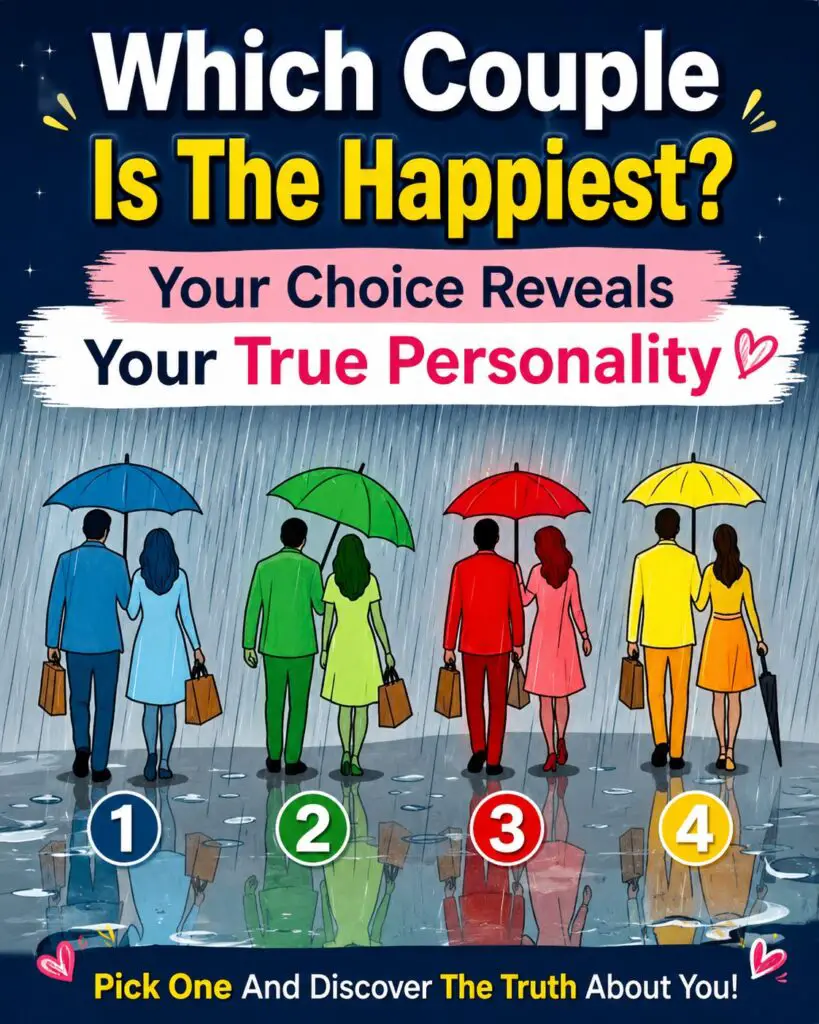
You’ve probably seen these viral relationship puzzles while scrolling online:
“Which couple looks the happiest?”
“Your answer reveals your true personality.”
At first glance, the game feels simple. Four couples stand under umbrellas in the rain, and you’re asked to choose which pair seems happiest. Within seconds, most people instinctively pick one.
Then comes the emotional twist:
Your answer supposedly reveals hidden truths about your personality, relationships, emotional intelligence, or romantic future.
But do these puzzles actually reveal anything meaningful?
The real answer is far more interesting than most people realize.
These viral image tests are not scientific personality assessments. They are psychological reflection tools that combine visual storytelling, emotional projection, and human pattern recognition. They work not because they uncover secret truths—but because they encourage you to interpret social cues through your own experiences and emotions.
Let’s explore why these puzzles feel so personal, what psychology says about them, and why millions of people love them anyway.
Why These Relationship Puzzles Go Viral
The human brain loves stories.
Even when looking at a simple image, people automatically begin creating emotional narratives.
In this puzzle, your brain instantly analyzes:
- body language
- posture
- distance between partners
- umbrella positioning
- walking patterns
- perceived affection
- color symbolism
Within seconds, you begin unconsciously deciding:
- who seems closest
- who looks relaxed
- who appears connected
- who feels emotionally distant
Why The Puzzle Feels Personal
The image creates emotional ambiguity.
There is no objectively correct answer.
That ambiguity allows each person to project their own beliefs and experiences onto the couples.
Someone who values independence may choose one pair.
Someone who values emotional closeness may choose another.
The meaning does not come from the image itself.
It comes from the viewer.
What Psychology Says About These Tests
These puzzles are examples of projective interpretation.
Projective interpretation happens when people assign personal meaning to vague or ambiguous information.
Similar To Inkblot Tests
The process resembles:
- Rorschach inkblots
- horoscope readings
- symbolic dream interpretation
- personality quizzes
The image acts like a mirror for your current emotional thinking.
The Barnum Effect
One major reason these tests feel accurate is something called the Barnum Effect.
This psychological phenomenon occurs when people accept broad, general statements as uniquely personal.
Examples include:
- “You value honesty but sometimes hide your emotions.”
- “You care deeply about relationships.”
- “You want connection but also need independence.”
These statements apply to most people, yet they feel individually meaningful.
That emotional resonance creates the illusion of deep personal insight.
What Your Choice May Actually Reflect
Although the puzzle cannot scientifically determine personality traits, your choice can still reflect something real about your current mindset.
Couple 1: Calm And Traditional
People drawn to Couple 1 often describe them as:
- stable
- calm
- emotionally secure
- dependable
This choice may reflect a preference for:
- reliability
- emotional safety
- long-term commitment
- quiet affection
The blue colors and balanced posture create feelings of trust and steadiness.
Couple 2: Energetic And Playful
Couple 2 may appeal to people who value:
- spontaneity
- excitement
- creativity
- youthful energy
The bright green colors often symbolize:
- growth
- freshness
- optimism
Someone choosing this pair may currently desire more fun or emotional freedom in relationships.
Couple 3: Passionate And Romantic
Couple 3 often attracts people drawn toward:
- passion
- emotional intensity
- romance
- confidence
The strong red color psychologically suggests:
- attraction
- energy
- bold emotion
Many viewers interpret this couple as emotionally expressive and highly connected.
Couple 4: Balanced And Mature
People who select Couple 4 sometimes perceive:
- harmony
- equality
- emotional balance
- peaceful companionship
Yellow commonly symbolizes:
- warmth
- positivity
- emotional openness
This pair may resonate with people seeking stable partnership without emotional drama.
Why Body Language Matters So Much
Humans instinctively read body language.
Long before language developed, humans survived by interpreting physical social cues.
What The Brain Notices Instantly
Without realizing it, your brain quickly evaluates:
- walking pace
- hand placement
- posture symmetry
- physical distance
- umbrella sharing
- movement coordination
Even tiny visual details shape emotional interpretation.
The Power Of Social Perception
Interestingly, different people often interpret the exact same body language differently.
That happens because interpretation depends heavily on:
- personal experiences
- cultural expectations
- past relationships
- emotional memories
Why People Love Relationship Personality Tests
These puzzles remain popular because they satisfy several deeply human emotional needs.
Curiosity About Relationships
Humans naturally want to understand:
- attraction
- love
- compatibility
- emotional behavior
Relationship-themed content feels instantly relatable.
Emotional Validation
People enjoy feeling understood.
Even simple personality interpretations can create feelings of:
- reassurance
- recognition
- emotional connection
Social Interaction
These puzzles also encourage conversation.
Friends compare answers.
Couples discuss interpretations.
Families debate which pair looks happiest.
The entertainment comes partly from shared discussion.
The Science Of First Impressions
One fascinating aspect of these puzzles is how quickly humans form judgments.
Research shows people often make social impressions within seconds.
Thin-Slice Judgments
Psychologists call these rapid conclusions thin-slice judgments.
Humans can instantly assess:
- confidence
- friendliness
- tension
- warmth
- emotional closeness
based on minimal visual information.
Sometimes these judgments are surprisingly accurate.
Other times they reflect personal bias.
Why There Is No “Correct” Happiest Couple
The puzzle becomes interesting because happiness itself is subjective.
Different people define happy relationships differently.
Some People Value:
- passion
- calmness
- excitement
- stability
- independence
- closeness
- humor
- loyalty
Each viewer unconsciously searches for the qualities they personally associate with happiness.
That’s why answers vary so widely.
The Role Of Color Psychology
Color strongly influences emotional interpretation.
Blue
Blue often suggests:
- calmness
- trust
- loyalty
- emotional safety
Green
Green commonly symbolizes:
- growth
- freshness
- harmony
- vitality
Red
Red psychologically connects to:
- passion
- attraction
- intensity
- confidence
Yellow
Yellow often represents:
- warmth
- positivity
- joy
- friendliness
Even if viewers do not consciously notice the colors, their brains still respond emotionally to them.
Why Humans Create Stories From Images
The human brain constantly builds narratives.
Even simple visual scenes trigger storytelling instincts.
Narrative Psychology
Psychologists believe storytelling helps humans:
- understand emotions
- predict behavior
- build social bonds
- organize memories
When viewing the couples, your brain automatically invents emotional stories:
- “They seem distant.”
- “They look deeply connected.”
- “They seem playful together.”
Those stories emerge instantly and often unconsciously.
Are These Tests Scientifically Reliable?
No.
A single image choice cannot accurately determine:
- personality type
- emotional intelligence
- relationship success
- compatibility
- psychological traits
Real psychological assessment requires:
- structured testing
- validated research
- repeated observation
- scientific methodology
But That Doesn’t Mean They’re Meaningless
Although the tests are not scientifically diagnostic, they can still encourage:
- self-reflection
- emotional awareness
- interesting conversation
- mindfulness about relationships
The value lies more in reflection than prediction.
Why Social Media Loves These Puzzles
These puzzles perform extremely well online because they combine:
- emotion
- curiosity
- simplicity
- personalization
The Perfect Viral Formula
People love content that:
- feels personal
- requires little effort
- invites discussion
- creates emotional intrigue
A simple image plus a mysterious promise becomes highly shareable.
A Healthier Way To View Personality Puzzles
Instead of asking:
“What does my answer predict?”
Try asking:
“Why did I feel drawn to that choice?”
That question often leads to deeper self-awareness.
Reflection Is More Valuable Than Prediction
Your choice may reveal:
- what qualities you admire
- what emotional needs matter most
- what relationship patterns feel familiar
- what kind of connection you currently crave
Those insights come from you—not from the puzzle itself.
What Truly Creates Happy Relationships
Real relationship happiness depends on much deeper factors than appearance alone.
Research consistently highlights:
- communication
- trust
- emotional support
- shared values
- respect
- conflict resolution
- affection
- consistency
A still image cannot capture the true complexity of human relationships.
Happiness Looks Different For Everyone
Some happy couples are:
- quiet and calm
- playful and loud
- independent
- deeply affectionate
- adventurous
- traditional
Healthy relationships do not follow one visual formula.
Why We Secretly Want Simple Answers
Part of the appeal comes from uncertainty.
Relationships are emotionally complicated.
People naturally search for shortcuts that simplify human behavior.
The Comfort Of Symbolic Meaning
Even when we know a test is not scientific, symbolic interpretations can still feel comforting because they:
- organize emotions
- create stories
- reduce uncertainty
- encourage reflection
Humans are meaning-making creatures.
Final Thoughts
“Which Couple Is the Happiest?” puzzles do not reveal your true personality in a scientific sense.
What they really reveal is something more human:
how your mind interprets connection, emotion, and relationships in a single moment.
Your answer reflects:
- your attention
- your emotional associations
- your experiences
- your current mindset
Not destiny.
Not hidden psychological secrets.
Not relationship prophecy.
Just the fascinating way humans naturally create meaning from images and stories.
And perhaps that’s why these puzzles remain so irresistible.
Because for a few brief moments, they invite us to pause, observe, and reflect on what happiness looks like to us personally.
Sometimes the most revealing part is not the answer itself—
but the story we create around it.