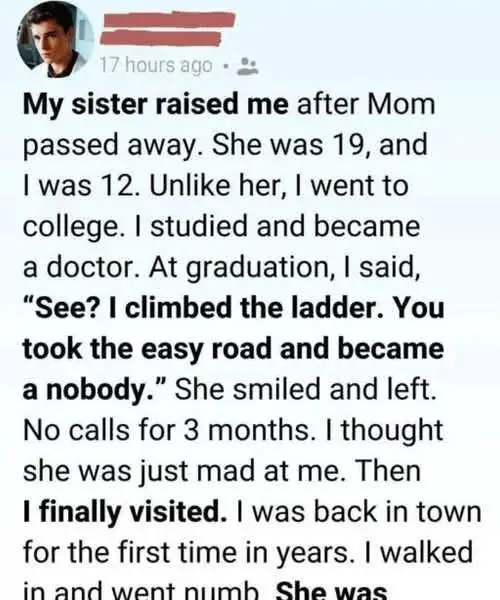
My sister raised me after our mother died.
She was only nineteen years old.
I was twelve.
While other girls her age worried about college classes, parties, and dating, she worried about rent, grocery bills, and whether I had clean clothes for school. She worked double shifts at a diner during the day and cleaned offices at night just to keep us afloat.
Back then, I never fully understood what she sacrificed.
All I saw was exhaustion.
Meanwhile, I promised myself something different. I told myself I would escape poverty. I would become successful. I would climb higher than anyone expected.
And eventually, I did.
I studied harder than anyone in my class. I earned scholarships. I graduated near the top of my university. Then I got into medical school.
For years, my sister supported me from the sidelines.
She mailed me small care packages even when she barely had enough money for herself. She called every Sunday asking whether I was eating enough. Sometimes she slipped twenty dollars into birthday cards even though I knew she needed it more than I did.
But success changed me in ways I didn’t notice at first.
I became arrogant.
I started measuring human worth by titles, salaries, and achievements. Somewhere along the way, I stopped seeing my sister as the person who saved me. Instead, I saw her as someone who “never did anything” with her life.
The worst part?
I believed it.
The day I graduated medical school, she sat proudly in the front row wearing the same old blue dress she had owned for years. I remember spotting her in the crowd while professors praised my accomplishments.
After the ceremony, people gathered around congratulating me.
That’s when I said the words I would spend the rest of my life regretting.
I laughed and told her:
“See? I climbed the ladder. You took the easy road and became a nobody.”
The moment the words left my mouth, her smile changed.
Not dramatically.
Just slightly.
A quiet crack in her expression.
But she still nodded gently and hugged me anyway.
Then she left.
For three months, she didn’t call.
At first, I assumed she was angry.
Honestly, part of me thought she was overreacting. I had become so consumed by my own success that I couldn’t understand why those words hurt so deeply.
Then one weekend, I returned to our hometown for a conference.
I decided to visit her.
It had been years since I’d really spent time there.
When I pulled into the driveway, something felt wrong immediately.
The yard was overgrown. Newspapers sat near the porch untouched. The curtains were closed.
I knocked.
No answer.
Eventually, a neighbor spotted me and slowly walked over.
The look on her face made my stomach drop.
“She never told you?” the woman asked quietly.
“Told me what?”
My sister had been sick.
Very sick.
For over a year.
Cancer.
Aggressive. Spreading fast.
The neighbor explained that my sister had hidden it from almost everyone. She continued working as long as she physically could. Even during chemotherapy, she still volunteered at the local shelter twice a week because she said other people “needed kindness too.”
I stood frozen.
I couldn’t breathe.
Then the neighbor handed me a small key.
“She wanted you to have this if you ever came back.”
Inside the house, everything looked smaller than I remembered.
The kitchen table where she helped me with homework.
The couch where she slept whenever I had nightmares after Mom died.
The tiny bedroom she gave up so I could have space to study.
I walked into her room and found stacks of medical bills hidden inside a drawer.
Under them sat dozens of letters.
All addressed to me.
Most were never mailed.
I opened one with trembling hands.
It read:
“I know he thinks I wasted my life. But I’m still proud of him every single day.”
Another said:
“I hope one day he understands that success isn’t always something people see.”
And another:
“Raising him was never the easy road. It was the honor of my life.”
By then, I was crying so hard I could barely read.
Then I found the final letter.
It was dated just one week after my graduation.
She wrote:
“His words hurt more than the illness. But I know pain can make people forget where they came from. I forgive him already.”
I collapsed onto the floor.
That was the moment I truly understood who my sister was.
She wasn’t a nobody.
She was the reason I became anybody at all.
While I collected degrees, she sacrificed her youth.
While I chased prestige, she carried responsibility no teenager should ever face.
While I learned medicine, she practiced love every single day without expecting recognition.
And worst of all, she never got to hear me say thank you.
She passed away two weeks before I came home.
At her funeral, people packed the church.
Former coworkers.
Neighbors.
Single mothers she had helped.
Teenagers she mentored.
Families she secretly bought groceries for during difficult winters.
One woman told me my sister used to leave food on her porch anonymously every month after her husband died.
Another said my sister paid for her son’s school supplies every year without taking credit.
I realized something devastating that day.
My sister had spent her entire life quietly saving people.
Not in hospitals.
Not with diplomas.
But through kindness.
And somehow, everyone knew her value except me.
For years afterward, I carried unbearable guilt.
No award, paycheck, or professional title could erase those final words I said to her.
But eventually, I began changing.
I started listening more carefully to people.
I stopped measuring worth through income or status.
I became a better doctor because I finally understood what healing actually looks like.
Sometimes healing is sacrifice.
Sometimes healing is patience.
Sometimes healing is a nineteen-year-old girl giving up her future so her little brother can have one.
Now, whenever young medical students ask me what success means, I tell them this:
The world notices titles.
But the people who quietly love, sacrifice, and carry others through darkness are often the true heroes.
My sister never became famous.
She never became wealthy.
But she became something far greater.
She became unforgettable.
More Easy Recipes
- Slow Cooker Onion Butter Potatoes: The Easiest Buttery Side Dish You’ll Ever Make
- The Church Ladies Empty This Tray Before the Potluck Even Officially Starts: 4-Ingredient Cucumber Sandwiches You’ll Make for Every Gathering
- Horrified Man Finds Something Unbelievable in a Bag of Broccoli He Purchased from Aldi
- 3-Ingredient Cherry Dessert