
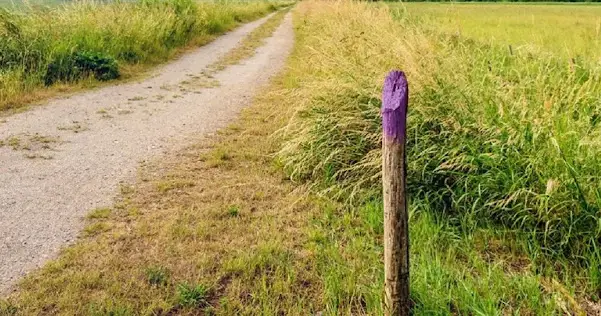
Imagine you’re enjoying a peaceful walk through the countryside. Birds are singing, the trail is quiet, and everything feels calm. Then, out of the corner of your eye, you notice something unusual—a bright purple stripe painted on a fence post or the trunk of a nearby tree.
At first glance, it might seem like an artistic choice or an attempt to brighten the landscape. Maybe the property owner simply liked the color purple.
In reality, that splash of paint carries an important message.
Across many parts of the United States, purple paint is far more than decoration. It serves as a legally recognized warning that the property beyond that point is private and should not be entered without permission.
For outdoor enthusiasts, hunters, hikers, photographers, and anyone exploring rural areas, understanding what this color represents can help prevent misunderstandings—and even legal trouble.
Let’s take a closer look at why this unusual system exists, how it works, and what you should do if you ever encounter it.
What Does Purple Paint Actually Mean?
In states that recognize what is commonly called the Purple Paint Law, a purple stripe painted on a tree, fence post, or another permanent object serves as the legal equivalent of a “No Trespassing” sign.
Instead of placing dozens of signs around miles of property lines, landowners can simply paint carefully placed purple marks to communicate that unauthorized entry is prohibited.
If someone crosses these boundaries without permission, they may be considered trespassing under state law, just as if they had ignored a traditional warning sign.
The system is simple, inexpensive, and remarkably effective.
Where Did the Purple Paint Law Come From?
The idea first gained legal recognition in Arkansas during the late 1980s.
Large rural properties often stretch for hundreds or even thousands of acres. Maintaining traditional warning signs along these boundaries proved difficult because signs frequently:
- Blew away during storms
- Rusted over time
- Became hidden by vegetation
- Were vandalized or stolen
- Needed constant replacement
Painting trees and fence posts solved many of these problems.
Once lawmakers recognized its practicality, other states gradually adopted similar legislation.
Today, numerous states throughout the U.S. have some version of the Purple Paint Law, although the exact requirements differ depending on local regulations.
Why Purple Instead of Another Color?
Many people naturally wonder why lawmakers selected purple rather than red, yellow, or orange.
The answer comes down to visibility and practicality.
Easy to Notice
Purple stands out exceptionally well against forests, grasslands, and farmland.
Natural landscapes rarely contain large patches of vivid purple, making the paint immediately noticeable from a distance.
Unlike green or brown, it doesn’t blend into surrounding vegetation.
Less Likely to Cause Confusion
Other bright colors already serve different purposes outdoors.
For example:
- Orange is commonly used for hunter safety clothing.
- Red may indicate hazards, utilities, or survey markers.
- Yellow frequently marks utilities or caution areas.
Purple offered a distinct color that wasn’t already heavily associated with another outdoor purpose.
That uniqueness helps eliminate confusion.
Designed to Last
Modern outdoor paints resist rain, sunlight, and changing temperatures.
A properly applied purple stripe can remain visible for years with very little maintenance, making it much more durable than paper or plastic signs.
Why Property Owners Prefer Purple Paint
For owners of farms, ranches, forests, and large rural properties, maintaining boundary signs can become expensive and time-consuming.
Purple paint provides several important advantages.
It Saves Money
Covering miles of fencing with metal signs can cost hundreds—or even thousands—of dollars.
A single can of weather-resistant paint can mark an extensive property at a fraction of the cost.
It Requires Less Maintenance
Signs eventually deteriorate.
Paint generally remains visible much longer and only needs occasional refreshing.
This reduces ongoing maintenance while still providing a clear warning.
It Discourages Vandalism
Unfortunately, warning signs are sometimes removed, stolen, or intentionally damaged.
Painted trees and fence posts are much harder to tamper with.
Even if someone scratches the surface, the mark can usually be restored quickly with another coat of paint.
It Clearly Defines Property Lines
For rural landowners, clearly marked boundaries help reduce accidental trespassing.
Hunters, hikers, ATV riders, and campers can immediately recognize that they are approaching private land and should stop or seek permission before continuing.
How Are Purple Boundary Marks Applied?
The paint cannot simply be splashed randomly onto a tree.
Most states that recognize purple paint specify guidelines regarding:
- The size of the painted stripe
- Its height above the ground
- The spacing between individual markers
- The type of permanent object used for marking
Although regulations vary, the goal remains consistent:
Anyone approaching the property should be able to recognize the boundary easily before accidentally crossing it.
What Should You Do If You See Purple Paint?
The safest response is straightforward.
If you notice clearly marked purple paint on trees, fence posts, or other permanent markers, assume you are approaching private property.
Instead of continuing forward:
- Stop and evaluate your surroundings.
- Look for additional purple markings that may indicate the property line.
- Turn around or choose another route.
- If appropriate, ask the landowner for permission before entering.
Many landowners are perfectly willing to grant access when approached respectfully.
The important point is obtaining permission first rather than assuming entry is allowed.
Which States Recognize Purple Paint as a No Trespassing Marker?
The Purple Paint Law has gradually expanded across the United States, although not every state has adopted identical regulations. While the exact wording and requirements vary, the underlying concept remains the same: a properly placed purple mark can legally notify the public that private property begins beyond that point.
States that have enacted some form of Purple Paint Law include:
- Arkansas
- Texas
- Florida
- Missouri
- Illinois
- Indiana
- North Carolina
- South Carolina
- Tennessee
- Virginia
- Kentucky
- Alabama
- Mississippi
- Louisiana
- Maine
Additional states have considered or introduced similar legislation over the years, so it’s always wise to check local laws before hiking, hunting, fishing, or exploring unfamiliar rural areas.
Are the Rules the Same Everywhere?
Not exactly.
Each state establishes its own legal requirements regarding how purple paint must be applied. These regulations ensure the markings are easy to recognize and difficult to misunderstand.
Although the details vary, many states require the markings to meet guidelines similar to these:
| Requirement | Typical Standard |
|---|---|
| Paint color | Bright or clearly visible purple |
| Shape | Vertical stripe |
| Length | Around 8 inches (20 cm) or more |
| Width | Approximately 1 inch (2.5 cm) |
| Height | Between 3 and 5 feet above ground |
| Spacing | Visible from one mark to the next along the property boundary |
These standards are designed to make the boundary obvious to anyone approaching on foot, horseback, bicycle, or vehicle.
Why Don’t Landowners Just Use Signs?
Traditional “No Trespassing” signs certainly work, but they come with several disadvantages.
Signs Can Disappear
Strong winds, heavy rain, snow, and falling branches can damage or remove signs over time.
In wooded areas, vegetation may eventually cover them entirely.
Signs Can Be Stolen
Unfortunately, metal signs are sometimes taken as souvenirs or intentionally vandalized.
A painted stripe on a tree or fence post is much harder to remove.
Large Properties Need Hundreds of Signs
Imagine owning several hundred acres of farmland or forest.
Posting signs every few yards along miles of property lines would require significant time and money.
Purple paint offers a much simpler solution.
Paint Lasts Longer
High-quality exterior paint withstands years of weather with minimal upkeep.
Every few years, landowners can simply apply another coat instead of replacing damaged signs.
Does Purple Paint Mean “No Hunting”?
Many people assume the paint only applies to hunting.
In reality, that’s usually not the case.
In most states where Purple Paint Laws exist, the marking indicates No Trespassing, which generally means people may not enter the property without permission for activities such as:
- Hunting
- Fishing
- Hiking
- Camping
- Riding ATVs
- Collecting firewood
- Photography
- Exploring
The restriction applies broadly unless the property owner grants permission.
What Happens If Someone Ignores the Purple Mark?
Crossing onto marked private property without authorization can have legal consequences.
Depending on the state and circumstances, trespassers may face:
- Warnings
- Fines
- Civil penalties
- Criminal trespassing charges
The severity often depends on factors such as whether the person knowingly ignored the markings, caused property damage, or refused to leave after being asked.
If you’re ever uncertain whether you’re on private land, it’s always safer to stop and verify before continuing.
What If You Accidentally Cross the Property Line?
Mistakes happen.
Trails can be poorly marked, GPS devices aren’t always accurate, and property boundaries may not be obvious.
If you realize you’ve crossed into an area marked with purple paint:
- Remain calm.
- Leave the property promptly.
- Avoid damaging crops, fences, or vegetation.
- If approached by the landowner, be polite and explain the mistake.
- Follow any instructions given.
Most accidental situations can be resolved respectfully when handled with honesty and courtesy.
Can You Paint Your Own Fence Purple?
Absolutely.
Simply painting your backyard fence purple because you enjoy the color is generally not illegal.
However, if you intentionally use purple markings in a way that falsely suggests ownership of land you don’t own or attempts to mislead the public, you could create legal problems.
Purple paint carries legal significance only when applied according to applicable state laws and on property owned or controlled by the person placing the markings.
Helpful Tips for Outdoor Enthusiasts
Whether you enjoy hiking, wildlife photography, birdwatching, or hunting, respecting private property helps maintain positive relationships between landowners and visitors.
Before heading into rural areas:
- Study maps before your trip.
- Stay on designated public trails.
- Pay attention to fences, gates, and painted markings.
- Carry offline maps or GPS if traveling into remote areas.
- Ask permission before entering private property.
- Leave gates exactly as you found them.
- Pack out all trash.
- Respect livestock and crops.
Responsible recreation protects both natural landscapes and private property rights.
Frequently Asked Questions
Does every purple fence mean “No Trespassing”?
No.
Only in states where Purple Paint Laws are recognized—and only when the paint has been applied according to state regulations.
Someone may simply like the color purple and paint an entire decorative fence that way.
Context matters.
Is faded purple paint still legally valid?
In many cases, yes.
Even if the paint has faded somewhat, it may still serve as a valid legal boundary marker.
Landowners are generally encouraged to refresh the paint periodically to keep it clearly visible.
Can purple paint appear on rocks?
Some states permit markings on permanent structures besides trees and fence posts, but the rules vary.
Always consult local regulations for specific requirements.
What if I don’t see the paint until after I’ve crossed?
Leave the property as soon as you recognize the boundary.
Remaining after noticing the markings could increase the likelihood of a trespassing issue.
Final Thoughts
At first glance, a bright purple stripe on a tree may seem like an unusual splash of color in the landscape. Yet for many rural communities across the United States, it serves a practical and legally recognized purpose.
Rather than relying on signs that can fade, break, or disappear, many landowners use purple paint as a durable, highly visible way to communicate that their property is private. The system helps reduce misunderstandings, protects farmland and wildlife habitats, and encourages respectful interactions between visitors and property owners.
If you’re exploring unfamiliar countryside, keep an eye out for these distinctive markings. Recognizing their meaning can help you avoid accidental trespassing and show consideration for the people who own and care for the land.
A simple stripe of purple paint may not look like much, but it represents something important: a clear boundary, a request for permission, and a reminder that respecting private property benefits everyone.