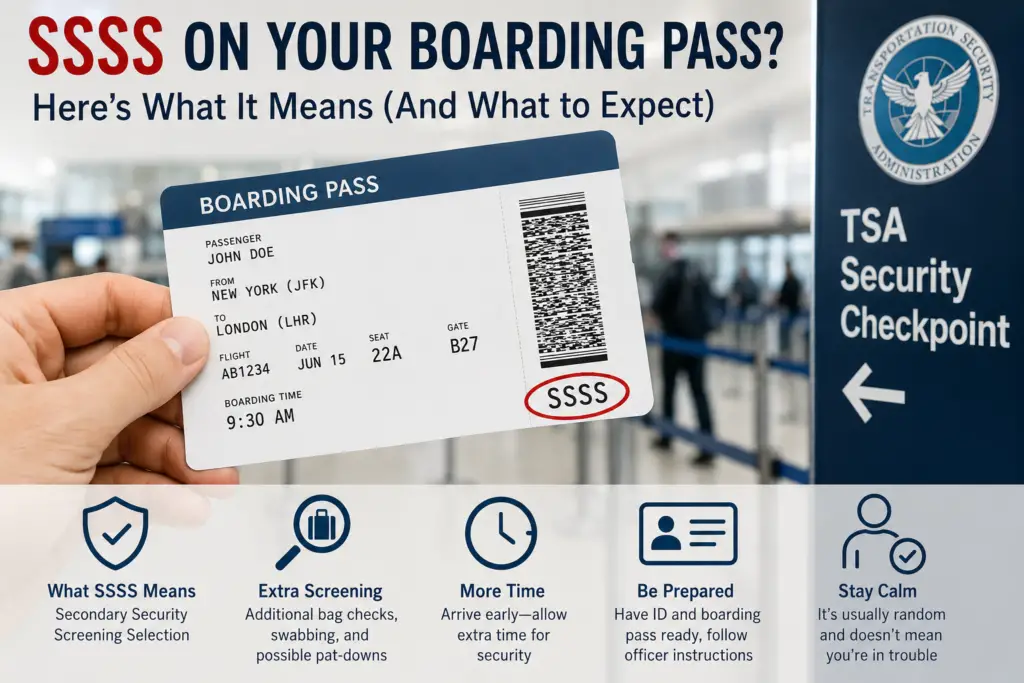
You arrive at the airport early, check your luggage, print your boarding pass, and head toward security feeling prepared for your trip. Then, while glancing at your boarding pass, you notice four letters printed near the barcode:
SSSS
If you’ve never seen it before, those four letters can immediately cause concern. Many travelers wonder if they’ve done something wrong, whether they’re on a government watchlist, or if they’ll miss their flight because of additional security procedures.
Fortunately, in most cases, the answer is much less alarming than many people assume.
SSSS stands for Secondary Security Screening Selection, a designation used on some boarding passes that indicates the traveler will receive additional security screening before boarding a flight. While the process may add extra time to your airport experience, it is not, by itself, an indication that you are suspected of wrongdoing.
Understanding what SSSS means—and what it doesn’t mean—can make the experience much less stressful.
What Does SSSS Stand For?
SSSS means Secondary Security Screening Selection.
The designation is used as part of aviation security procedures designed to enhance passenger safety.
If your boarding pass contains these four letters, Transportation Security Administration (TSA) officers or equivalent airport security personnel may conduct additional screening before allowing you to proceed to your gate.
The purpose is to strengthen aviation security through enhanced screening procedures.
For most travelers, the process is simply an additional layer of security.
Why Does SSSS Appear on a Boarding Pass?
Many travelers assume receiving SSSS means they have done something wrong.
That is generally not the case.
Government agencies do not publicly disclose the exact criteria used for security screening selections. However, security experts and official guidance indicate that travelers may be selected for additional screening for a variety of reasons, including random security measures or other security-related factors.
Because the selection process is intentionally not fully public, it is impossible to know exactly why any individual traveler receives the designation.
Importantly, receiving SSSS does not automatically mean:
- You are under investigation.
- You are on a watchlist.
- You committed any offense.
- You are prohibited from flying.
Many ordinary travelers experience SSSS at some point.
What Happens During Secondary Screening?
The exact procedures vary depending on the airport, destination, and security agency involved.
However, travelers may experience several additional steps.
Additional Identity Verification
Security officers may verify your identification and boarding pass more carefully than during standard screening.
This helps confirm passenger identity before boarding.
Carry-On Bag Inspection
Your carry-on luggage may receive additional inspection.
Officers may ask you to:
- Open your bag
- Remove electronics
- Separate certain items
- Allow manual inspection
These procedures help identify prohibited items that automated screening may require closer examination to evaluate.
Explosive Trace Detection
One of the most common additional procedures involves explosive trace detection.
Officers may gently swab:
- Your hands
- Shoes
- Carry-on luggage
- Electronic devices
- Clothing
The swabs are analyzed by specialized equipment designed to detect trace explosive materials.
This process usually takes only a few moments.
Additional Pat-Down
Some travelers may receive a more thorough physical screening.
Officers explain each step before beginning.
Professional procedures are followed throughout the inspection.
Questions About Your Luggage
You may be asked routine questions such as:
- Did you pack your own bags?
- Have your bags remained with you?
- Is anyone traveling with you?
- Are you carrying prohibited items?
These questions are standard components of many security screening procedures.
How Much Extra Time Should You Expect?
Additional screening usually adds only a short amount of time.
However, processing times vary depending on:
- Airport size
- Passenger volume
- Staffing levels
- Flight schedules
- Security procedures
Travel experts generally recommend arriving early for all flights.
If your boarding pass contains SSSS, allowing extra time can help reduce unnecessary stress.
Can You Still Use TSA PreCheck?
In some situations, travelers selected for secondary screening may receive additional procedures even if they participate in expedited screening programs.
Security officers determine required screening based on current procedures rather than traveler preference.
Does SSSS Mean You’re on a Watchlist?
No.
Receiving SSSS does not, by itself, indicate that someone is on a government watchlist.
Individuals on official watchlists are generally subject to entirely different procedures.
Most travelers who receive SSSS continue through security and board their flights without further issues.
Common Myths About SSSS
Myth 1: It Means You’re in Trouble
False.
Most people selected complete screening and continue their trip normally.
Myth 2: It Always Happens for the Same Reason
False.
The specific selection process is not publicly disclosed and may involve multiple factors.
Myth 3: You’ll Miss Your Flight
Usually not.
Additional screening generally takes only a limited amount of extra time, especially when travelers arrive early.
Myth 4: It Will Happen Every Time You Fly
Not necessarily.
Some travelers experience SSSS once and never see it again.
Others may receive it occasionally.
Tips for a Smoother Screening Experience
If you notice SSSS on your boarding pass, remaining calm can make the process easier.
Helpful suggestions include:
Arrive Early
Extra screening may require additional time.
Allowing extra time helps reduce pressure.
Organize Your Carry-On
Keep electronics, travel documents, and liquids easily accessible.
Organization speeds inspections.
Wear Simple Clothing
Avoid unnecessary metal accessories when possible.
This may simplify screening.
Follow Instructions
Security officers perform standardized procedures designed to maintain safety.
Listening carefully and cooperating respectfully helps the process move efficiently.
Remain Patient
Additional screening is usually completed quickly.
Staying calm benefits both travelers and security personnel.
Why Aviation Security Uses Multiple Layers
Modern aviation security relies on several overlapping protective measures rather than a single checkpoint.
These layers include:
- Identity verification
- Baggage screening
- Metal detection
- Explosive detection
- Random screening
- Behavioral observation
- Technology-based screening systems
Multiple layers reduce reliance on any one security measure.
Can You Avoid SSSS?
There is no guaranteed way to avoid receiving SSSS.
Because the selection process is not publicly disclosed, travelers cannot reliably predict when it will occur.
The best approach is simply to:
- Arrive early
- Bring valid identification
- Follow airline instructions
- Cooperate during screening
International Travel Considerations
Additional screening may be more common on certain international routes because different countries maintain their own aviation security requirements.
Procedures can vary depending on:
- Departure country
- Destination country
- Airline
- Airport
Regardless of destination, the overall goal remains protecting passengers and crew.
What Happens After Screening?
Once additional screening is completed successfully, travelers simply continue through the airport like everyone else.
In most cases, there are no additional restrictions.
You can:
- Visit airport shops
- Purchase food
- Wait at your gate
- Board your flight normally
For most passengers, the extra screening becomes little more than a brief delay.
Final Thoughts
Seeing “SSSS” on your boarding pass can be surprising, especially if you’ve never encountered it before. However, the designation simply means you have been selected for additional security screening before your flight. It does not automatically indicate suspicion, wrongdoing, or placement on a government watchlist.
The screening process may include extra baggage inspection, identity verification, explosive trace testing, or additional screening procedures, but it is generally completed within a short period. Arriving at the airport early, keeping your documents organized, and remaining patient can help make the experience much smoother.
Air travel security is designed to protect everyone on board. While additional screening may feel inconvenient, understanding the purpose behind SSSS can help transform uncertainty into confidence and allow you to focus on the journey ahead.