In a world filled with smart devices, viral social media tips, and endless products promising to make life easier, it’s easy to forget that some of the best solutions were discovered long before the internet existed. Long before video tutorials and online influencers, people relied on observation, experience, and practical knowledge passed down from one generation to the next.
These old-fashioned life hacks weren’t developed in laboratories or marketing departments. They emerged from everyday people solving real problems with the tools and resources they already had. Farmers, homemakers, mechanics, teachers, and grandparents learned through trial and error what worked and what didn’t. Over time, the most effective tricks survived because they delivered consistent results.
What makes these traditional tips so remarkable is their simplicity. Most require little effort, cost almost nothing, and use items already found around the house. Even in today’s modern world, many of these techniques remain surprisingly effective.
Whether you’re looking to save money, reduce waste, simplify household chores, or simply appreciate the wisdom of previous generations, these timeless life hacks deserve a place in your daily routine.
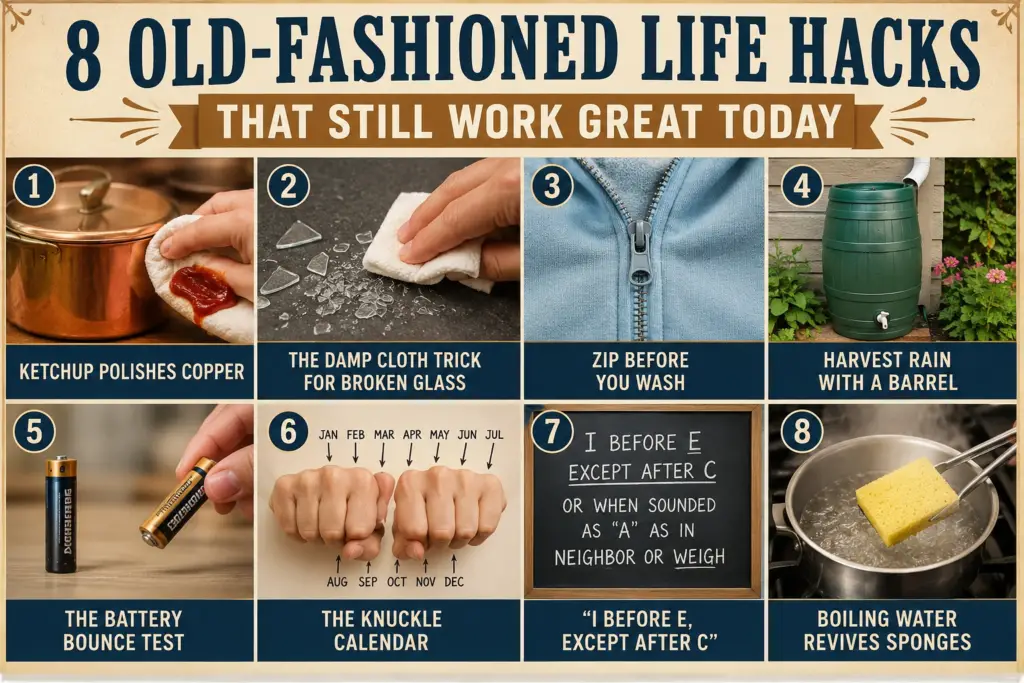
Let’s explore eight old-fashioned life hacks that continue to prove their value year after year.
1. Ketchup Can Restore Tarnished Copper
At first glance, it sounds absurd.
Why would a condiment belong anywhere near household cleaning supplies?
Yet many grandparents knew a secret that modern cleaning product advertisements rarely mention: ketchup can be an excellent copper cleaner.
Why It Works
Copper naturally develops tarnish over time. Exposure to air and moisture causes oxidation, creating a dull, darkened appearance.
Ketchup contains:
- Tomatoes
- Vinegar
- Salt
The mild acids found in tomatoes and vinegar help break down tarnish, while the salt provides gentle abrasive action.
Together, they create a surprisingly effective cleaning solution.
How to Use It
Apply a small amount of ketchup directly to the tarnished copper surface.
Allow it to sit for several minutes.
Using a soft cloth, gently rub the surface in circular motions.
Rinse thoroughly with warm water and dry completely.
The difference can be dramatic.
Many people are amazed at how quickly old copper items regain their shine.
Best Uses
This trick works well on:
- Copper cookware
- Decorative copper items
- Copper mugs
- Antique copper accents
While commercial copper cleaners exist, this simple kitchen solution often produces excellent results at a fraction of the cost.
2. The Damp Cloth Method for Tiny Glass Shards
Few household accidents create more anxiety than broken glass.
Large pieces are easy to spot and sweep up. The real danger comes from the tiny fragments that remain behind.
These nearly invisible shards can cause injuries long after the initial cleanup appears complete.
The Problem With Brooms Alone
Even thorough sweeping often leaves microscopic pieces behind.
Glass fragments can settle into:
- Tile grout
- Hardwood floor cracks
- Carpet fibers
- Corners and edges
Walking barefoot afterward becomes risky.
The Traditional Solution
After removing the larger pieces, lightly dampen a paper towel or cloth.
Press it gently across the affected area.
The moisture helps small shards adhere to the fabric.
When you lift the cloth, many hidden pieces come with it.
Why It Still Works
Unlike vacuum cleaners, which can sometimes spread fragments or damage equipment, the damp cloth method physically captures tiny pieces.
It’s simple, inexpensive, and remarkably effective.
Even today, many professional cleaners recommend this technique after glass breakage.
3. Zip Your Clothes Before Washing
This hack may seem minor, but it can dramatically extend the life of your clothing.
The Hidden Damage Caused by Open Zippers
Open zippers behave like tiny metal saws inside the washing machine.
During the wash cycle, zipper teeth can snag:
- Sweaters
- T-shirts
- Underwear
- Delicate fabrics
- Athletic wear
This causes:
- Pulls
- Snags
- Tears
- Premature wear
A Five-Second Fix
Before placing garments in the washer:
- Fully zip jackets
- Zip jeans
- Close hoodies
- Fasten zipper pockets
This simple habit protects both the garment itself and everything else in the load.
Long-Term Benefits
Over time, this small action can:
- Extend clothing lifespan
- Reduce fabric damage
- Preserve garment appearance
- Prevent costly replacements
It’s one of those classic habits that requires almost no effort yet provides consistent benefits.
4. Collect Rainwater With a Rain Barrel
Long before modern irrigation systems became common, people understood the value of rainwater.
Rather than allowing valuable water to run off rooftops and disappear into storm drains, they captured it for future use.
Why Rainwater Is Valuable
Rainwater is naturally soft and free from many of the minerals found in treated water supplies.
Many plants actually prefer rainwater because it more closely resembles their natural growing conditions.
Benefits of Rain Barrels
A rain barrel can help:
- Reduce water bills
- Conserve resources
- Support gardens during dry periods
- Decrease runoff
- Promote sustainable living
Setting Up a Simple System
Position a rain barrel beneath a downspout.
When rain falls, water collects inside the barrel rather than being wasted.
The stored water can then be used for:
- Flower beds
- Vegetable gardens
- Potted plants
- Outdoor cleaning
This centuries-old practice remains one of the easiest ways to conserve water.
5. The Battery Bounce Test
Most households contain a drawer full of batteries with questionable usefulness.
Some are new.
Some are dead.
Many fall somewhere in between.
The challenge is determining which is which without specialized equipment.
The Simple Test
Hold an alkaline battery vertically about an inch above a hard surface.
Drop it straight down.
Observe what happens.
Interpreting the Results
Fresh batteries tend to:
- Land firmly
- Produce a dull thud
- Remain relatively stable
Depleted batteries often:
- Bounce higher
- Fall over easily
- Rebound more dramatically
Why It Happens
As alkaline batteries discharge, chemical changes occur inside.
These changes alter internal structure and elasticity, affecting how the battery behaves upon impact.
While not perfectly accurate, the bounce test provides a quick estimate when no battery tester is available.
6. The Knuckle Calendar Trick
Even in the age of smartphones, many people still forget how many days are in certain months.
Fortunately, an ancient memory trick offers a simple solution.
How It Works
Make two fists.
Place them side by side.
Each knuckle represents a month with 31 days.
Each valley between knuckles represents a shorter month.
Starting with January:
- January = knuckle
- February = valley
- March = knuckle
- April = valley
Continue across both hands.
Why People Love It
The knuckle calendar requires:
- No technology
- No memorization of complicated rules
- No reference materials
Once learned, it remains useful for life.
Many people first learned this trick as children and still use it decades later.
7. “I Before E, Except After C”
English spelling contains countless inconsistencies.
However, one old rule continues helping students and adults alike.
The Classic Rule
“I before E, except after C.”
Examples include:
- Believe
- Piece
- Chief
After C:
- Receive
- Ceiling
- Conceit
The Exceptions
English wouldn’t be English without exceptions.
Words such as:
- Weird
- Science
- Height
break the rule.
Nevertheless, it remains useful for many commonly used words.
Why It Endures
Memory aids survive because they simplify learning.
Even imperfect rules provide structure that helps people remember complex information.
For generations, this phrase has reduced spelling confusion and boosted writing confidence.
8. Boiling Water Can Refresh Sponges
Kitchen sponges work hard.
Unfortunately, they also become breeding grounds for bacteria.
The Problem
Sponges absorb:
- Food particles
- Grease
- Moisture
These conditions encourage bacterial growth and unpleasant odors.
The Traditional Solution
Place the sponge in boiling water for approximately ten minutes.
The heat helps reduce microorganisms while refreshing the sponge.
Afterward:
- Allow it to cool
- Squeeze out excess water
- Air dry thoroughly
Important Note
This method can extend sponge usefulness, but it doesn’t eliminate the need for replacement.
Heavily worn or damaged sponges should still be discarded.
Nevertheless, boiling can provide additional use before replacement becomes necessary.
Why Old-Fashioned Life Hacks Continue to Survive
The true power of these hacks lies in their practicality.
They survive because they work.
Unlike many trends that come and go, these techniques have endured through decades of real-world testing.
They Save Money
Most require items already available at home.
They Reduce Waste
Many extend the life of household products.
They Simplify Everyday Tasks
Simple solutions often outperform complicated alternatives.
They Promote Self-Reliance
Learning practical skills builds confidence and independence.
They Connect Generations
These hacks represent knowledge passed from one generation to another.
Each tip carries a small piece of history.
The Wisdom Hidden in Everyday Experience
Modern technology has undoubtedly improved many aspects of life.
However, innovation doesn’t automatically replace wisdom.
Many old-fashioned life hacks emerged because people had limited resources and needed creative solutions.
Those constraints often produced remarkably effective ideas.
The result is a collection of practical knowledge that remains valuable today.
While gadgets change and trends evolve, human needs remain surprisingly consistent.
We still need cleaner homes.
We still need functioning clothes.
We still need organized households.
And sometimes the simplest solution remains the best one.
Final Thoughts
The next time you encounter a household problem, consider looking backward before looking forward.
The solution may already exist in the form of a simple trick passed down through generations.
Whether you’re polishing copper with ketchup, collecting rainwater, testing batteries, or cleaning up broken glass, these old-fashioned life hacks demonstrate an important truth:
Good ideas don’t become obsolete simply because they’re old.
In fact, the very fact that people continue using them decades later may be the strongest evidence of their effectiveness.
Sometimes the smartest innovations aren’t new at all—they’re timeless.
And in a world constantly searching for the next big thing, there’s something wonderfully reassuring about knowing that a little old-fashioned wisdom still goes a long way.