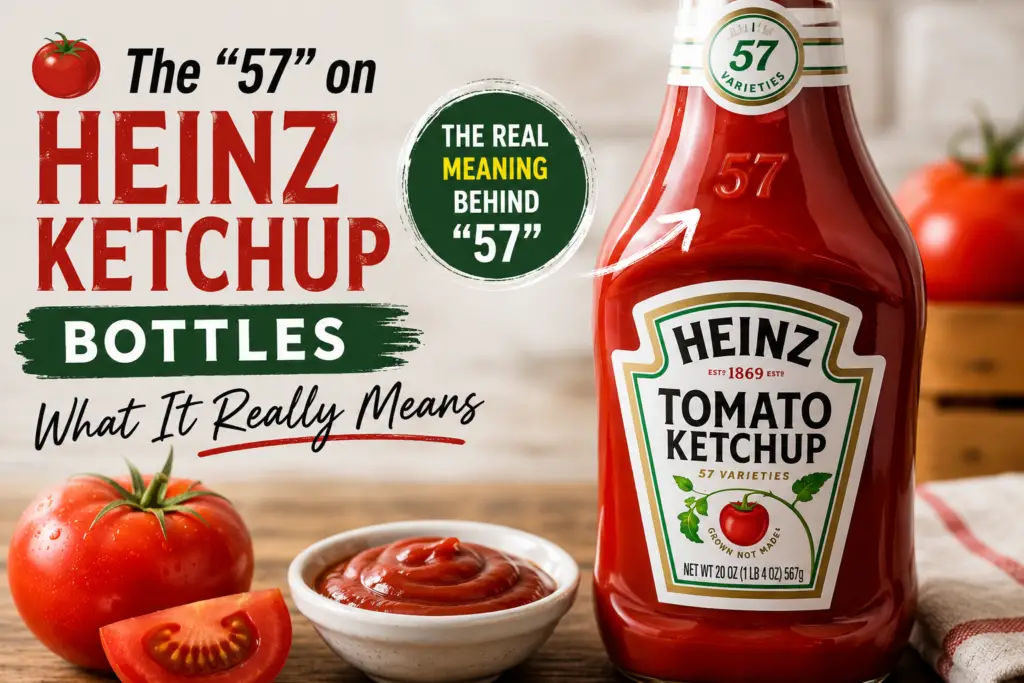
Walk into almost any grocery store in America, and you’ll find one of the most recognizable bottles in food history sitting on the shelf: Heinz Ketchup. For generations, families have squeezed it onto burgers, fries, hot dogs, and countless other meals. Yet despite its popularity, one small detail on the bottle continues to spark curiosity.
What does the number 57 actually mean?
Many people assume it refers to ingredients, recipe variations, factory codes, or even the number of countries where the product is sold. Some believe it marks a secret formula or special manufacturing process.
The truth is much simpler—and much more fascinating.
The famous “57” printed on Heinz ketchup bottles is one of the greatest examples of successful branding in business history. More than a century after it first appeared, millions of people still recognize it instantly, proving that sometimes the most powerful marketing ideas are also the simplest.
Let’s explore the surprising story behind Heinz’s famous number, how it became a global symbol, and why it continues to appear on ketchup bottles today.
The Mystery Behind the Number
Take a close look at a bottle of Heinz ketchup.
You’ll notice the number “57” prominently displayed on the label or embossed into the glass. It stands out enough that many consumers naturally assume it must represent something important about the ketchup itself.
Surprisingly, it doesn’t.
The number has nothing to do with:
- The recipe
- The number of ingredients
- Tomato varieties
- Factory locations
- Manufacturing dates
- Nutritional information
- Product formulas
Instead, the number originated from a marketing slogan created by the company’s founder more than 125 years ago.
Meet the Man Behind the Brand
The story begins with Henry J. Heinz.
Born in 1844, Heinz demonstrated entrepreneurial talent at an early age. As a young boy, he grew vegetables in his family’s garden and sold them for profit. His interest in quality food products eventually led him to build what would become one of the world’s most successful food companies.
At a time when food packaging standards were often inconsistent and consumers had little trust in manufacturers, Heinz focused heavily on quality, cleanliness, and transparency.
His products quickly gained a reputation for reliability.
However, Heinz understood something else that many business owners overlooked:
A great product still needs great marketing.
The Birth of “57 Varieties”
In the late nineteenth century, Heinz was traveling through New York City when he noticed an advertisement promoting “21 styles” of shoes.
The simplicity of the number caught his attention immediately.
Numbers were memorable.
People remembered them.
They stood out.
Inspired by the idea, Heinz decided his own company needed a similar slogan.
At the time, the Heinz company already produced far more than 57 products. In fact, estimates suggest the company offered well over 60 different food items.
Yet Heinz chose the number 57 anyway.
Why?
Because he liked it.
According to company history, Heinz reportedly believed the number 5 had a pleasing appearance, while the number 7 felt lucky and memorable.
When combined, “57 Varieties” sounded catchy, distinctive, and easy to remember.
The slogan was born.
Why the Number Was Marketing Genius
Today, marketers spend billions of dollars studying consumer behavior.
Back in the late 1800s, Heinz instinctively understood several marketing principles that remain effective today.
1. It Was Easy to Remember
Simple numbers stick in people’s minds.
Consumers might forget product details, but they remember memorable phrases.
“57 Varieties” was short, clear, and distinctive.
2. It Suggested Abundance
Even though the company already sold more than 57 products, the number implied variety and choice.
Customers interpreted it as a sign that Heinz offered something for everyone.
3. It Created Curiosity
People naturally wondered:
“Why 57?”
That curiosity sparked conversations and increased brand awareness.
4. It Was Consistent
The slogan appeared everywhere:
- Product labels
- Advertisements
- Posters
- Delivery vehicles
- Store displays
- Packaging
Consistency helped strengthen recognition.
The Number Became Bigger Than the Products
One of the most remarkable aspects of the Heinz story is how the number eventually became more famous than the slogan itself.
Many people recognize “57” today without knowing the phrase “57 Varieties.”
The number evolved from a marketing message into a brand symbol.
Very few companies achieve this level of recognition.
Think about some of the world’s most iconic brands.
Many have logos.
Some have mascots.
Others have colors.
Heinz has a number.
And people instantly know what it represents.
The Hidden Feature Most People Don’t Know About
There is another interesting fact about the famous “57.”
For decades, Heinz encouraged customers to tap the bottle at the embossed “57” mark when trying to get ketchup out.
Many people instinctively hit the bottom of the bottle.
However, Heinz suggested tapping near the neck where the “57” appears.
The company’s explanation was that this location helped release the ketchup more effectively.
Whether or not everyone agrees, the advice became another part of Heinz folklore.
It also reinforced awareness of the number itself.
Even the bottle design worked as marketing.
Why Heinz Never Removed It
Over the years, companies frequently redesign products.
Logos change.
Packaging evolves.
Slogans disappear.
Yet the “57” remains.
Why?
Because it has become part of the company’s identity.
Removing it would be like removing a piece of history.
The number connects modern consumers with generations of customers who bought Heinz products before them.
It symbolizes:
- Tradition
- Reliability
- Familiarity
- Heritage
- Consistency
These qualities are extremely valuable in the food industry.
People trust brands they recognize.
The Psychology Behind Familiar Brands
There is a psychological reason why symbols like the Heinz 57 continue to matter.
Humans naturally gravitate toward familiarity.
Researchers call this the “mere exposure effect.”
The more often people encounter something, the more positively they tend to view it.
For over a century, consumers have seen the number 57.
As a result, it creates feelings of:
- Comfort
- Trust
- Reliability
- Nostalgia
Even consumers who know nothing about its origin often associate it with quality simply because it has been present for so long.
How Heinz Changed Food Marketing Forever
The success of the 57 slogan helped influence generations of advertisers.
Before Heinz, many companies focused primarily on describing products.
After Heinz, businesses increasingly focused on creating memorable identities.
The lesson was simple:
People don’t just buy products.
They buy stories.
They buy familiarity.
They buy symbols.
The number 57 became a story consumers could remember.
That story continues today.
Fun Facts About Heinz
Here are some interesting facts many people don’t know:
Heinz Had More Than 57 Products
Even when the slogan launched, the company already sold significantly more than 57 items.
The number was never intended to be literal.
The Number Was Chosen Personally
Henry Heinz selected the number because he liked how it sounded.
There was no scientific formula behind it.
The Slogan Survived for Generations
Very few advertising slogans remain recognizable more than a century after creation.
The Number Became a Trademark
Today, 57 is inseparable from Heinz branding.
It Is Recognized Worldwide
People across multiple continents associate the number with Heinz products.
Common Myths About the Number 57
Myth: It Represents 57 Ingredients
False.
The ketchup recipe does not contain 57 ingredients.
Myth: It Refers to Tomato Varieties
False.
The number has no connection to tomato species.
Myth: It Marks Factory Production Codes
False.
Production codes are separate from branding.
Myth: Heinz Had Exactly 57 Products
False.
The company already offered more products than that.
Myth: The Number Has Scientific Meaning
False.
Its primary purpose has always been marketing.
Why Consumers Still Love the Story
Part of the appeal lies in its simplicity.
In an age filled with complicated marketing campaigns, algorithms, and digital advertising strategies, the Heinz story reminds us that effective branding does not need to be complex.
One memorable number.
One simple slogan.
One consistent message.
That was enough.
The story also highlights how human decision-making often relies more on emotion than logic.
The number 57 has no practical impact on ketchup quality.
Yet it makes the product feel familiar and trustworthy.
That emotional connection is powerful.
The Lasting Legacy of “57 Varieties”
More than a hundred years after Henry Heinz chose those two numbers, they continue to appear on bottles around the world.
Generations have grown up seeing them.
Millions recognize them instantly.
Most importantly, they demonstrate how a simple idea can endure when it captures people’s attention.
The “57” is no longer just a number.
It is a symbol of one of the most successful branding efforts in food history.
Frequently Asked Questions
What does the 57 on Heinz ketchup bottles mean?
It comes from the historic slogan “57 Varieties,” created by company founder Henry J. Heinz.
Did Heinz actually have 57 products?
No. The company already produced more than 57 products when the slogan was introduced.
Why did Heinz choose 57?
He reportedly liked the appearance and sound of the numbers 5 and 7.
Does the number affect the ketchup recipe?
No. It has nothing to do with ingredients or production.
Why is the number still used today?
Because it has become an iconic part of Heinz’s brand identity and history.
Final Thoughts
The famous “57” on Heinz ketchup bottles is proof that great marketing can outlive generations.
What began as a simple advertising slogan evolved into one of the most recognizable symbols in the food industry. It was never about ingredients, recipes, or manufacturing secrets. Instead, it was about creating something memorable.
More than a century later, the number still accomplishes exactly what Henry Heinz intended—it captures attention, sparks curiosity, and keeps people talking.
Sometimes the most powerful ideas are not the most complicated.
Sometimes they’re simply the ones people never forget.