
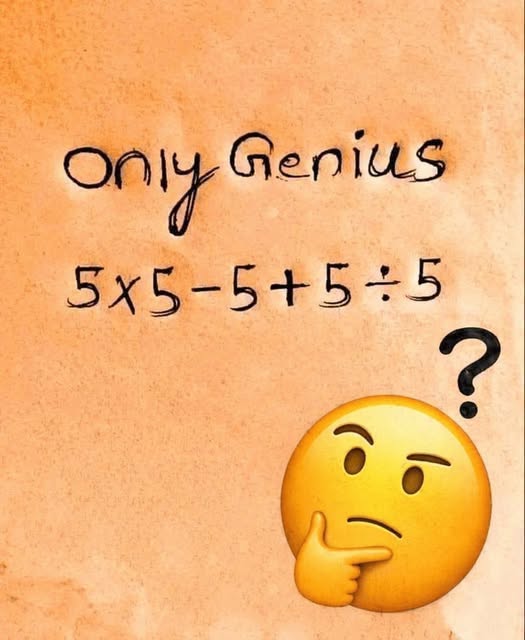
At first glance, it looks like a simple elementary-school math problem. Nothing intimidating. No advanced formulas. No algebra. No calculus. Just a handful of numbers and basic operations.
Yet thousands of people online are getting it wrong.
The puzzle that’s been making the rounds on social media asks:
5 × 5 − 5 + 5 ÷ 5 = ?
Many people confidently answer 3.
Others insist the answer is 21.
So who’s right?
The surprising truth is that this seemingly simple equation reveals a lot about how our brains process information, why viral math puzzles spread so quickly, and how easily even smart people can overlook fundamental mathematical rules.
Let’s break it down.
Why This Puzzle Tricks So Many People
When most people look at the equation, their brains naturally start grouping numbers together.
The expression contains several fives:
5 × 5 − 5 + 5 ÷ 5
Because the numbers are visually similar and close together, many people instinctively perform operations in the order that feels most natural rather than following the formal rules of mathematics.
A common incorrect approach looks like this:
- 5 × 5 = 25
- 5 + 5 = 10
- 25 − 10 = 15
- 15 ÷ 5 = 3
This method seems logical because it follows a pattern our brains find satisfying.
The problem?
Mathematics doesn’t work according to visual patterns or intuition.
It follows precise rules.
And those rules determine the correct answer every time.
The Rule That Changes Everything
Mathematicians use a system known as the Order of Operations.
In many countries, students learn it through the acronym:
PEMDAS
Which stands for:
- Parentheses
- Exponents
- Multiplication
- Division
- Addition
- Subtraction
Some people learn the equivalent acronym BODMAS:
- Brackets
- Orders
- Division
- Multiplication
- Addition
- Subtraction
While the names vary, the underlying principle remains the same.
Certain operations must be completed before others.
This ensures that everyone solving the same equation arrives at the same answer.
Without these rules, mathematics would become inconsistent and unreliable.
Solving the Puzzle Correctly
Let’s apply the order of operations.
The original equation is:
Step 1: Complete Multiplication and Division
Perform multiplication first:
5 × 5 = 25
Perform division:
5 ÷ 5 = 1
The equation now becomes:
25 − 5 + 1
Step 2: Complete Addition and Subtraction from Left to Right
Now work left to right:
25 − 5 = 20
20 + 1 = 21
Final Answer
21
That is the mathematically correct solution.
Why People Keep Getting 3
The answer of 3 comes from accidentally changing the structure of the equation.
When people mentally combine the two middle fives first, they’re effectively treating the expression as though it contains hidden parentheses:
(5 × 5) − (5 + 5) ÷ 5
That would indeed produce a different result.
But those parentheses don’t exist.
And in mathematics, you cannot invent grouping symbols that aren’t written.
This is exactly why viral puzzles like this become so popular.
They exploit the gap between instinctive thinking and mathematical thinking.
The Psychology Behind Viral Math Puzzles
Interestingly, these puzzles aren’t really testing intelligence.
They’re testing attention.
Researchers who study cognitive psychology have long known that the human brain relies on shortcuts called heuristics.
These shortcuts help us make decisions quickly.
Most of the time, they’re useful.
Sometimes, however, they cause mistakes.
When we see a familiar pattern, our brains often assume they already know what’s happening.
Instead of carefully analyzing every step, we jump directly to a conclusion.
That tendency is exactly what these puzzles exploit.
The puzzle isn’t difficult because the math is advanced.
It’s difficult because it looks too simple.
Does Getting It Wrong Mean You’re Bad at Math?
Absolutely not.
Many highly educated people answer incorrectly when they rush.
The issue usually isn’t mathematical ability.
It’s speed.
Social media encourages rapid responses.
People glance at a problem for a few seconds and immediately post an answer.
The faster we move, the more likely we are to skip important details.
That’s why teachers often emphasize showing your work.
The process matters just as much as the answer.
Why Mathematicians Insist on Order of Operations
Imagine three people solving the same equation.
Without an agreed-upon system, each person might choose a different order.
One might multiply first.
Another might add first.
A third might divide first.
The same equation could produce multiple answers.
Mathematics would become useless.
The order of operations exists so everyone speaks the same mathematical language.
Whether you’re building a bridge, programming a computer, calculating a mortgage, or launching a spacecraft, consistency matters.
The rules eliminate ambiguity.
Common Mistakes Similar to This Puzzle
This isn’t the only equation that causes confusion.
Consider:
8 ÷ 2(2 + 2)
Or:
6 ÷ 2 × 3
These expressions frequently spark online debates.
In reality, the correct solution depends on applying the same principles consistently.
Most disagreements occur because people unconsciously insert grouping where none exists.
The lesson remains the same:
Follow the rules exactly as written.
Why Social Media Loves These Challenges
There’s a reason these puzzles generate thousands of comments.
They’re highly engaging.
People love:
- Testing themselves
- Comparing answers
- Defending their reasoning
- Challenging friends
Unlike complex math problems, these puzzles appear accessible to everyone.
That makes participation easy.
And because many people arrive at different answers, discussions quickly become heated.
In some cases, the debate becomes more popular than the puzzle itself.
A Quick Mental Workout
Let’s try another example:
12 ÷ 3 + 2 × 4
Many people want to calculate:
12 ÷ 3 = 4
3 + 2 = 5
Then continue.
But the correct process is:
- 12 ÷ 3 = 4
- 2 × 4 = 8
- 4 + 8 = 12
Again, multiplication and division come before addition.
Once you recognize the pattern, these puzzles become much easier.
The Real Lesson
The most valuable takeaway from puzzles like this has nothing to do with genius-level intelligence.
It has everything to do with slowing down.
Our brains naturally seek shortcuts.
They love efficiency.
Sometimes that’s helpful.
Sometimes it leads us astray.
Whether you’re solving a math equation, making an important decision, or evaluating information online, taking an extra moment to verify the details can make all the difference.
In this puzzle, that extra moment transforms an incorrect answer of 3 into the correct answer of 21.
And perhaps that’s why these viral challenges remain so popular.
They’re not just testing our math skills.
They’re reminding us that careful thinking often beats quick thinking.
Final Answer
For the equation:
5 × 5 − 5 + 5 ÷ 5
The correct answer is:
21
Did you get it right on your first try?