
There are certain objects that instantly make you curious.
You spot them while traveling through an old town, wandering a historic neighborhood, or admiring photographs of charming Southern homes. They seem familiar and unfamiliar at the same time. You know they’re important because they’ve occupied a place of honor for generations, yet few people outside the region know what they are.
One such object is the joggling board.
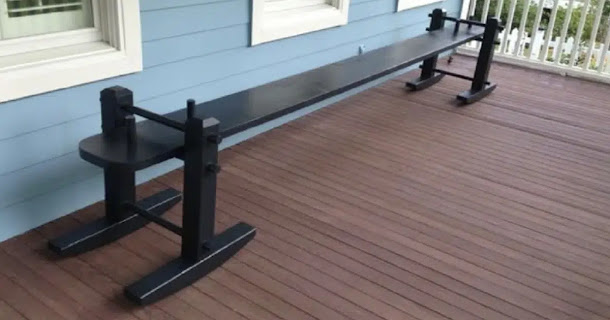
At first glance, it looks like a cross between a bench, a rocking chair, and a porch swing. It’s long, narrow, and slightly elevated. When someone sits on it, it moves with a gentle bouncing motion unlike any other piece of outdoor furniture.
To many visitors, it appears strange.
To generations of Southerners, however, it represents comfort, conversation, hospitality, romance, and tradition.
The story behind the joggling board is far more fascinating than most people realize.
A Curious Piece of Porch Furniture
Imagine walking up to a beautiful Southern home.
A wide porch stretches across the front of the house. Ceiling fans turn slowly overhead. The scent of jasmine drifts through the air. Rocking chairs line the walls.
Then you notice something unusual.
A long wooden plank sits balanced on curved supports.
Someone sits down.
The entire structure begins to bounce gently.
That is a joggling board.
Unlike a porch swing that hangs from chains or ropes, a joggling board rests on specially designed curved rockers.
The result is a soothing motion somewhere between rocking and floating.
The movement is subtle.
Gentle.
Rhythmic.
And surprisingly relaxing.
Many people who sit on one for the first time immediately understand why it has survived for more than two centuries.
The Unexpected Origin Story
The history of the joggling board begins in South Carolina during the early nineteenth century.
According to historical accounts, a Charleston resident named Cleland Kinloch invited his widowed sister, Mary Kinloch Huger, to live with him around 1804.
Mary suffered from physical discomfort and joint pain.
Traveling by carriage was difficult.
Even ordinary movement could be uncomfortable.
Concerned about her health, relatives in Scotland reportedly sent her an unusual piece of furniture designed to provide gentle movement without requiring strenuous activity.
That furniture was the earliest known joggling board.
The idea was remarkably simple.
The slight bouncing motion allowed Mary to enjoy the sensation of movement without enduring painful carriage rides.
The gentle rocking offered comfort and relaxation.
Most importantly, it allowed her to spend time outdoors on the porch, where fresh air and social interaction were considered important for overall well-being.
What began as a thoughtful gift soon attracted attention.
Visitors noticed it.
Neighbors became interested.
Before long, other families wanted one too.
A local curiosity quickly evolved into a regional tradition.
Why the South Embraced the Joggling Board
Many inventions fade into obscurity.
The joggling board did the opposite.
It flourished.
The reason is simple.
It fit perfectly into Southern culture.
Long before air conditioning became common, porches served as essential living spaces.
Families gathered there in the evenings.
Neighbors stopped by to chat.
Children played nearby.
Guests were welcomed with sweet tea and conversation.
Life unfolded on the porch.
The joggling board enhanced this experience.
Its gentle motion encouraged people to sit longer.
Conversations lasted longer.
Stories grew richer.
Connections deepened.
The board became more than furniture.
It became part of the social fabric of Southern life.
In many communities, the front porch functioned almost like an outdoor living room.
The joggling board fit naturally into that environment.
The Famous Courting Tradition
Perhaps the most romantic chapter in the joggling board’s history involves its reputation as a courting bench.
Over time, local folklore began associating the boards with romance.
Families noticed that young couples enjoyed sitting together on them.
The design itself encouraged interaction.
Unlike wide benches where people could sit far apart, joggling boards naturally brought people closer together.
When one person moved, the entire board responded.
The other person felt it immediately.
A shared rhythm developed.
The gentle bouncing motion created an atmosphere that felt both intimate and comfortable.
Parents appreciated the arrangement.
Couples could spend time together on the front porch where courtship remained visible and socially acceptable.
Young people appreciated it too.
The board offered a rare opportunity for private conversation while remaining within the bounds of social expectations.
Stories began circulating that homes with joggling boards were more likely to see successful marriages.
Whether true or not, the reputation stuck.
Soon the joggling board became known in many places as a courting bench.
It wasn’t merely furniture anymore.
It became a symbol of romance.
A Masterpiece of Simple Engineering
One reason the joggling board remains fascinating is its elegant simplicity.
The design has changed very little over the years.
Traditional boards often measure between eight and twelve feet long.
A sturdy wooden plank forms the seating surface.
Curved rockers at each end create the characteristic motion.
The dimensions may vary slightly depending on the maker, but the principle remains the same.
Sit down.
Push gently.
Feel the board bounce.
The experience feels surprisingly modern despite its historical origins.
Many first-time users compare it to a combination of a porch swing, a glider, and a rocking chair.
Yet it remains distinctly different from all three.
The motion is smoother.
More subtle.
More communal.
It invites conversation rather than isolation.
Craftsmanship and Southern Pride
Joggling boards also showcase the South’s rich woodworking tradition.
Historically, craftsmen built boards from locally available materials such as cypress and pine.
These woods resisted moisture and insect damage.
Because many boards lived outdoors year-round, durability mattered.
Skilled artisans took pride in their work.
Each board reflected careful attention to detail.
Curves needed precise shaping.
Balance required accuracy.
Even small errors could affect the movement.
As a result, well-made joggling boards became treasured family possessions.
Many were passed from one generation to the next.
Some historic examples remain in use today.
Their continued survival speaks to the quality of their construction.
The Modern Revival
In recent years, interest in traditional craftsmanship has grown dramatically.
People increasingly seek ways to slow down.
To disconnect.
To spend meaningful time outdoors.
As a result, the joggling board has experienced something of a revival.
Homeowners across the United States now install them on porches, patios, and gardens.
Some appreciate the historical connection.
Others simply enjoy the unique motion.
Designers have embraced the trend as well.
Modern versions appear in a variety of finishes and materials.
Some maintain a traditional appearance.
Others incorporate contemporary design elements.
Despite these updates, the spirit remains unchanged.
The joggling board still serves the same purpose it always has.
It brings people together.
More Than Furniture
What makes the joggling board special isn’t the wood.
It isn’t the craftsmanship.
It isn’t even the motion.
What makes it special is what happens when people sit on it.
Conversations begin.
Stories are shared.
Laughter emerges naturally.
Time slows down.
In an age dominated by screens, notifications, and constant distractions, the joggling board offers something increasingly rare.
Presence.
You cannot rush while sitting on a joggling board.
You cannot multitask effectively.
The gentle motion encourages mindfulness.
You become aware of the breeze.
The sounds around you.
The people beside you.
The moment itself.
Perhaps that explains why the tradition continues to endure.
Why It Still Matters Today
The world has changed dramatically since the first joggling board arrived in Charleston.
Technology transformed communication.
Transportation evolved.
Homes became larger and more sophisticated.
Yet human needs remain remarkably similar.
People still crave connection.
They still enjoy meaningful conversations.
They still seek moments of peace.
The joggling board addresses all of those desires.
Its enduring popularity reminds us that not every innovation needs electronics, apps, or complicated features.
Sometimes the simplest ideas prove the most lasting.
A wooden plank.
Two curved rockers.
A gentle bounce.
That is all it takes.
Final Thoughts
The next time you encounter a joggling board on a Southern porch, you’ll know you’re looking at far more than an unusual bench.
You’re looking at a piece of living history.
A symbol of hospitality.
A relic of old-fashioned courtship.
A masterpiece of practical craftsmanship.
And perhaps most importantly, a reminder that some of life’s greatest pleasures are also its simplest.
Sit down.
Feel the gentle motion.
Listen to the stories around you.
Take a moment to slow down.
After all, that is exactly what the joggling board has been encouraging people to do for more than two hundred years.
In a world that never seems to stop moving, perhaps that’s the most valuable tradition of all.