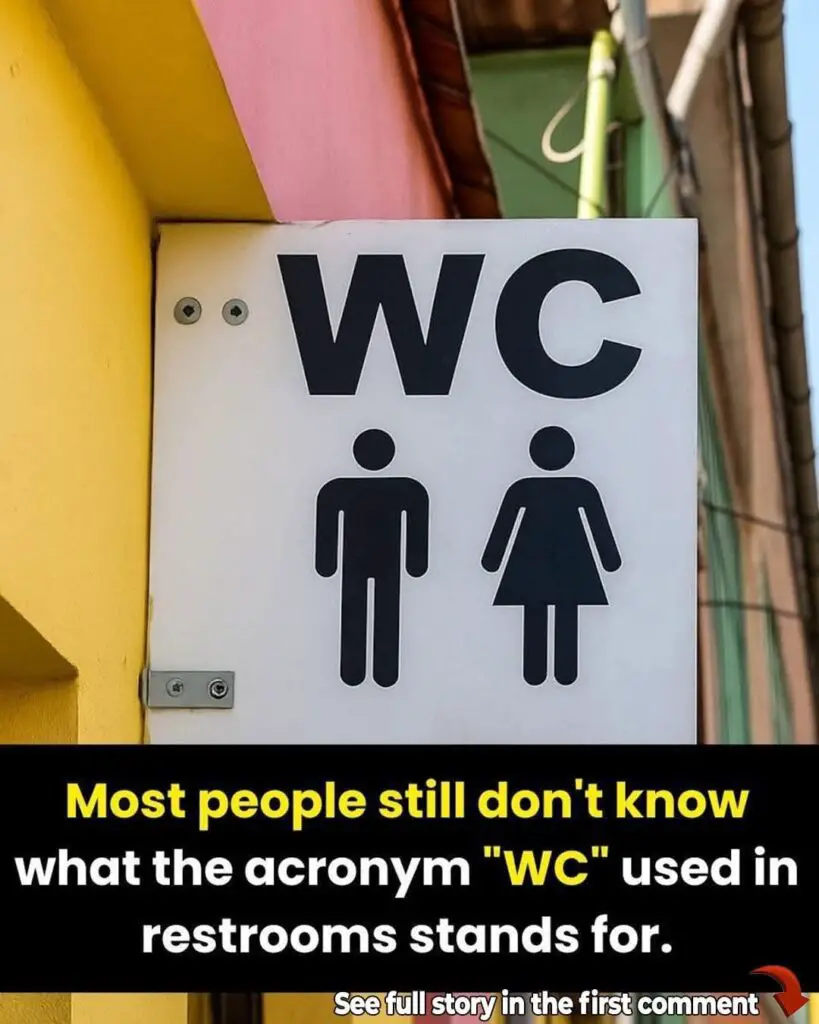
Have you ever traveled abroad, walked through an airport, train station, hotel, or shopping center, and spotted a sign labeled simply “WC”?
For many people, those two letters are instantly recognizable. Yet for countless others, the abbreviation remains one of travel’s most common little mysteries.
You may know where the sign leads, but have you ever stopped to wonder what “WC” actually stands for?
Surprisingly, many adults are only now discovering the answer.
The abbreviation appears throughout Europe, the United Kingdom, and countless international destinations. Despite its widespread use, the meaning behind it often goes unexplained.
The answer is simple:
WC stands for Water Closet.
While the term might sound old-fashioned today, it has a fascinating history that stretches back to the early days of indoor plumbing and modern sanitation.
Let’s explore how this curious abbreviation originated, why it remains so common around the world, and what it reveals about the evolution of bathrooms as we know them.
What Does WC Mean?
The letters WC stand for Water Closet.
The phrase originated during the nineteenth century when indoor plumbing began transforming homes and public buildings.
Breaking down the term is surprisingly straightforward:
- Water refers to the running water used for flushing.
- Closet refers to a small enclosed room.
Put together, a water closet was literally a small private room containing a flush toilet.
Unlike modern bathrooms, these rooms often contained only a toilet and nothing else.
At the time, this distinction was important because bathing facilities and toilet facilities were frequently located in separate spaces.
Today, many people assume bathrooms have always looked the way they do now, but history tells a very different story.
Before Indoor Plumbing Changed Everything
For most of human history, there was no such thing as a modern bathroom.
People relied on:
- Outhouses
- Chamber pots
- Privies
- Public latrines
- Communal facilities
Bathing was also a completely separate activity.
Many homes contained dedicated bathing rooms where water was manually carried and heated before use.
Meanwhile, toilets were located elsewhere.
When indoor plumbing emerged during the Victorian era, architects faced a challenge.
Homes already had bathing rooms.
Where should the new flush toilets go?
The solution was simple.
Install them inside small private rooms connected directly to the new water supply.
Those rooms became known as water closets.
The name stuck.
Why Water Closets Became So Popular
The arrival of water closets represented a major leap forward in public health and personal hygiene.
For the first time, people could dispose of waste safely inside their homes without relying on outdoor facilities.
This innovation offered several advantages:
Improved Sanitation
Running water dramatically reduced exposure to human waste.
Cities experienced major improvements in public health as indoor plumbing systems expanded.
Greater Privacy
Water closets provided a dedicated private space for personal needs.
This was a significant cultural shift from earlier communal systems.
Increased Convenience
No more nighttime trips to outdoor privies.
Families gained safe, accessible facilities inside their homes.
Modern Living Standards
Having a water closet quickly became a symbol of progress and modernization.
As cities expanded, indoor plumbing became an increasingly important feature of everyday life.
Why We Still See WC Signs Today
Considering the term originated more than a century ago, many people wonder why WC remains so common.
The answer lies in simplicity and international recognition.
Unlike words such as:
- Bathroom
- Restroom
- Toilet
- Washroom
WC transcends language barriers.
Travelers from different countries can instantly recognize it.
This universal understanding makes it ideal for public signage.
You’ll commonly find WC signs in:
- Airports
- Train stations
- Hotels
- Museums
- Restaurants
- Government buildings
- Tourist attractions
Because only two letters are required, WC also saves valuable space on signs.
In many countries, the abbreviation has become so deeply embedded in culture that replacing it would feel unnecessary.
Different Countries, Different Names
One interesting aspect of bathrooms is how differently they are described around the world.
United States
Americans commonly use:
- Restroom
- Bathroom
- Men’s Room
- Ladies’ Room
Canada
The preferred term is often:
- Washroom
United Kingdom
Common terms include:
- Toilet
- Loo
- WC
Australia
Many Australians casually say:
- Dunny
- Toilet
France
You’ll frequently see:
- Toilettes
Germany
The common term is:
- Toiletten
Despite these differences, WC often appears alongside local terminology because international visitors recognize it instantly.
The Fascinating Evolution of Modern Bathrooms
The history of bathrooms is actually a story of human innovation.
Many people are surprised to learn that sophisticated sanitation systems existed thousands of years ago.
Ancient Rome
The Romans built extensive public latrines featuring:
- Running water
- Drainage systems
- Communal seating
Their engineering remains impressive even by modern standards.
Medieval Europe
Following the decline of Rome, sanitation standards often deteriorated.
Many people relied on chamber pots and outdoor facilities.
Victorian Era
The nineteenth century brought revolutionary improvements:
- Indoor plumbing
- Flush toilets
- Sewer systems
- Running water
The water closet emerged during this period.
Modern Day
Today’s bathrooms combine:
- Toilets
- Showers
- Bathtubs
- Sinks
- Ventilation
- Advanced plumbing
The modern bathroom is essentially the result of centuries of engineering progress.
Why So Many People Never Knew What WC Meant
The internet recently rediscovered the meaning of WC through social media discussions and viral videos.
Thousands of people admitted they had spent years seeing the abbreviation without ever knowing its origin.
There are several reasons for this.
People Rarely Need to Ask
Most travelers eventually learn that WC points toward a restroom.
Once they know its function, curiosity often ends there.
The Phrase Sounds Old-Fashioned
“Water Closet” isn’t commonly used in everyday conversation.
As a result, many people never encounter the full term.
Modern Bathrooms Are Different
Today’s bathrooms usually contain more than just a toilet.
Because of this, the original meaning has become less obvious over time.
Language Evolves
Words frequently outlive the circumstances that created them.
WC remains familiar even though most people no longer use the phrase water closet in conversation.
Fun Facts About Toilets and Water Closets
Here are a few surprising restroom facts many people don’t know:
The First Flush Toilet
A version of the flush toilet was invented by Sir John Harington in 1596.
The Phrase “Spend a Penny”
Public toilets in Victorian England often cost one penny to use.
This gave rise to the expression “spend a penny.”
Thomas Crapper Didn’t Invent the Toilet
Although his name became famous in plumbing history, Thomas Crapper primarily improved and popularized existing designs.
Modern Toilets Save Water
Today’s toilets use significantly less water than many older models, making them more environmentally friendly.
WC Is One of the World’s Most Recognized Abbreviations
Few two-letter abbreviations are understood across as many countries and languages.
The Universal Language of Restroom Signs
Today, symbols often communicate restroom locations even more effectively than words.
Most public facilities use internationally recognized icons that help travelers navigate unfamiliar environments.
Still, WC remains a trusted backup.
It combines:
- Simplicity
- History
- International recognition
- Practicality
That’s why it continues appearing on signs throughout the world.
Frequently Asked Questions
Is WC the same as a bathroom?
Not exactly. Traditionally, a water closet referred specifically to a room containing a toilet, while a bathroom contained bathing facilities.
Why don’t Americans use WC very often?
American English generally favors the terms bathroom and restroom. WC is understood but rarely used in everyday speech.
Is Water Closet an outdated term?
The full phrase is less common today, but the abbreviation WC remains widely used.
Why is WC common in Europe?
The abbreviation is internationally recognized and easily understood regardless of language.
Can a modern bathroom still be called a water closet?
In some architectural plans and real estate descriptions, the term is still used to describe a separate toilet room within a larger bathroom.
Final Thoughts
The next time you see a sign labeled WC, you’ll know there’s more behind those two simple letters than most people realize.
What appears to be an ordinary restroom sign is actually a small piece of history.
The term “Water Closet” emerged during one of humanity’s most important technological transformations—the arrival of indoor plumbing.
It represented improved sanitation, greater privacy, and a major step forward in public health.
Today, although most people simply think of it as another restroom sign, WC remains a reminder of how dramatically everyday life has changed over the last century.
Sometimes the most familiar signs hide the most interesting stories.
And now, whenever you spot those two letters on a door, you’ll know exactly what they mean—and the fascinating history behind them.