
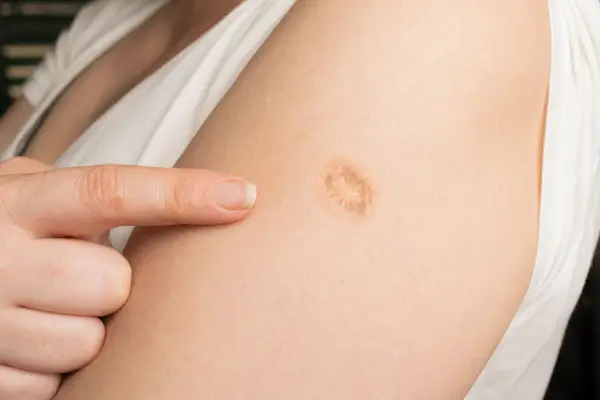
Have you ever noticed a small, round scar on someone’s upper arm—or maybe on your own?
It’s subtle. Often slightly indented. Sometimes lighter or darker than the surrounding skin. And for many people, it’s just… there.
No clear memory. No obvious explanation.
Over the years, this little mark has sparked countless theories:
- A childhood burn
- A mysterious skin condition
- A cultural or ritual mark
- Even something contagious
But the real story is far more powerful.
👉 That small circular scar is likely from the smallpox vaccine—and it represents one of the greatest achievements in human history.
🔍 What Is That Round Scar?
The mark you’re seeing is typically a vaccination scar left by the smallpox vaccine, which was widely administered around the world from the mid-20th century until the early 1980s.
Unlike modern vaccines, this one was very different in how it was given—and how the body responded.
💉 A Unique Vaccination Method
The smallpox vaccine didn’t use a standard injection.
Instead, healthcare workers used a special tool called a bifurcated needle (a tiny forked needle).
Here’s what happened:
- The needle was dipped into a solution containing a live but weakened virus (called vaccinia)
- The skin was pricked multiple times—usually about 15 quick punctures
- This created a controlled local reaction
Then, over days to weeks:
- A small blister formed
- It turned into a pustule
- It scabbed over
- And eventually healed
👉 The final result: a round, permanent scar
🧬 Why Did It Leave a Scar?
Modern vaccines rarely leave visible marks—but the smallpox vaccine intentionally triggered a strong local immune reaction.
This was actually a sign that the vaccine worked.
The visible stages (blister → scab → scar) showed:
👉 Your immune system had successfully responded
The scar is simply the healed tissue from that process.
🌍 Why Do Some People Have It — And Others Don’t?
This depends almost entirely on when and where you were born.
If You Likely Have the Scar:
You may have it if you were:
- Born before the early 1980s
- Living in regions where smallpox vaccination was routine
(Africa, Asia, Latin America, Eastern Europe)
If You Likely Don’t Have It:
You may not have it if:
- You were born after ~1980–1985
- You grew up in countries that stopped vaccination earlier
For example:
- In the United States, routine civilian vaccination ended in 1972
- Globally, vaccination campaigns stopped after 1980
Special Cases
Some people vaccinated later include:
- Military personnel
- Certain laboratory workers
- Healthcare professionals handling related viruses
🦠 Why Did We Stop the Vaccine?
Because something extraordinary happened:
👉 Smallpox was eradicated.
In 1980, the World Health Organization officially declared that smallpox—the deadly disease that once killed millions—was completely eliminated.
This remains:
👉 The only human disease ever eradicated
⚔️ A Disease That Changed History
Before eradication, smallpox was one of the most feared diseases on Earth.
It caused:
- Severe fever
- Painful skin lesions
- Permanent scarring
- Blindness in many cases
And in the 20th century alone:
👉 It killed an estimated 300 million people
🌐 A Global Effort Like No Other
The eradication of smallpox wasn’t an accident.
It was the result of:
- Massive international cooperation
- Door-to-door vaccination campaigns
- Coordination across political enemies
During the Cold War:
- The United States and the Soviet Union worked together
- Teams reached remote villages and dense cities
- Millions were vaccinated worldwide
👉 Your small scar is part of that story.
❌ Common Myths About the Scar (Debunked)
Let’s clear up the confusion.
❌ “It’s from a burn or skin disease”
👉 No.
It’s a controlled vaccine reaction, not an injury.
❌ “It’s from a TB test”
👉 Not exactly.
- TB skin tests (tuberculin tests) do NOT leave scars
- The BCG vaccine (for tuberculosis) can leave a mark
But:
- BCG scars are usually smaller and less defined
- The classic round scar is most often from smallpox
❌ “It means I had smallpox”
👉 No.
You were protected from it, not infected by it.
The vaccine used a related virus (vaccinia), not the smallpox virus itself.
❌ “It’s cultural or ritual scarification”
👉 No.
While scarification exists in some cultures, this specific scar:
- Has a uniform medical appearance
- Was given through vaccination programs
❌ “It’s dangerous or contagious”
👉 Absolutely not.
The scar is:
- Fully healed
- Inactive
- Completely harmless
💡 How Effective Was the Smallpox Vaccine?
Extremely effective.
- Protection lasted about 3–5 years at full strength
- Partial immunity could last much longer
Most importantly:
👉 It helped eliminate a deadly global disease
🧠 Why This Scar Still Matters Today
Even though smallpox is gone, the scar remains meaningful.
It reminds us:
- Science can solve global problems
- Vaccination saves lives
- Collaboration across countries is possible
❤️ A Different Way to See It
Many people once felt embarrassed by this scar.
They tried to hide it.
But the perspective is changing.
👉 It’s not a flaw.
👉 It’s not damage.
It’s:
- A symbol of survival
- A mark of protection
- A piece of global history
📸 Looking at the Image
In the image you shared, the mark:
- Is circular
- Slightly indented
- Located on the upper arm
👉 These are classic characteristics of a smallpox vaccination scar.
🧭 What If You’re Not Sure?
If you’re unsure whether your scar is from a vaccine or something else, consider:
- Age (born before 1980s?)
- Location (upper arm?)
- Shape (round, defined?)
If in doubt, a healthcare provider can confirm.
❓ FAQs
Can the scar fade over time?
Yes, it may become less visible—but usually does not disappear completely.
Can it be removed?
- Cosmetic treatments may reduce appearance
- But removal is rarely necessary
Do modern vaccines leave scars?
👉 No.
Most modern vaccines are designed to avoid visible marks.
Why don’t we vaccinate against smallpox anymore?
Because the disease no longer exists in the natural world.
💬 Final Thought
That small round scar on your arm is easy to overlook.
But it carries a powerful message.
It tells a story of:
- A disease that once devastated humanity
- A global effort that defeated it
- A moment when science and cooperation changed history
So the next time you see it—on yourself or someone else—remember:
👉 It’s not just a scar.
👉 It’s a victory.
“Some marks don’t represent harm.
They represent the moment humanity chose to protect itself—and succeeded.”
⚠️ Disclaimer
This article is for educational purposes only and does not replace professional medical advice. If you have concerns about skin changes or scars, consult a healthcare provider.